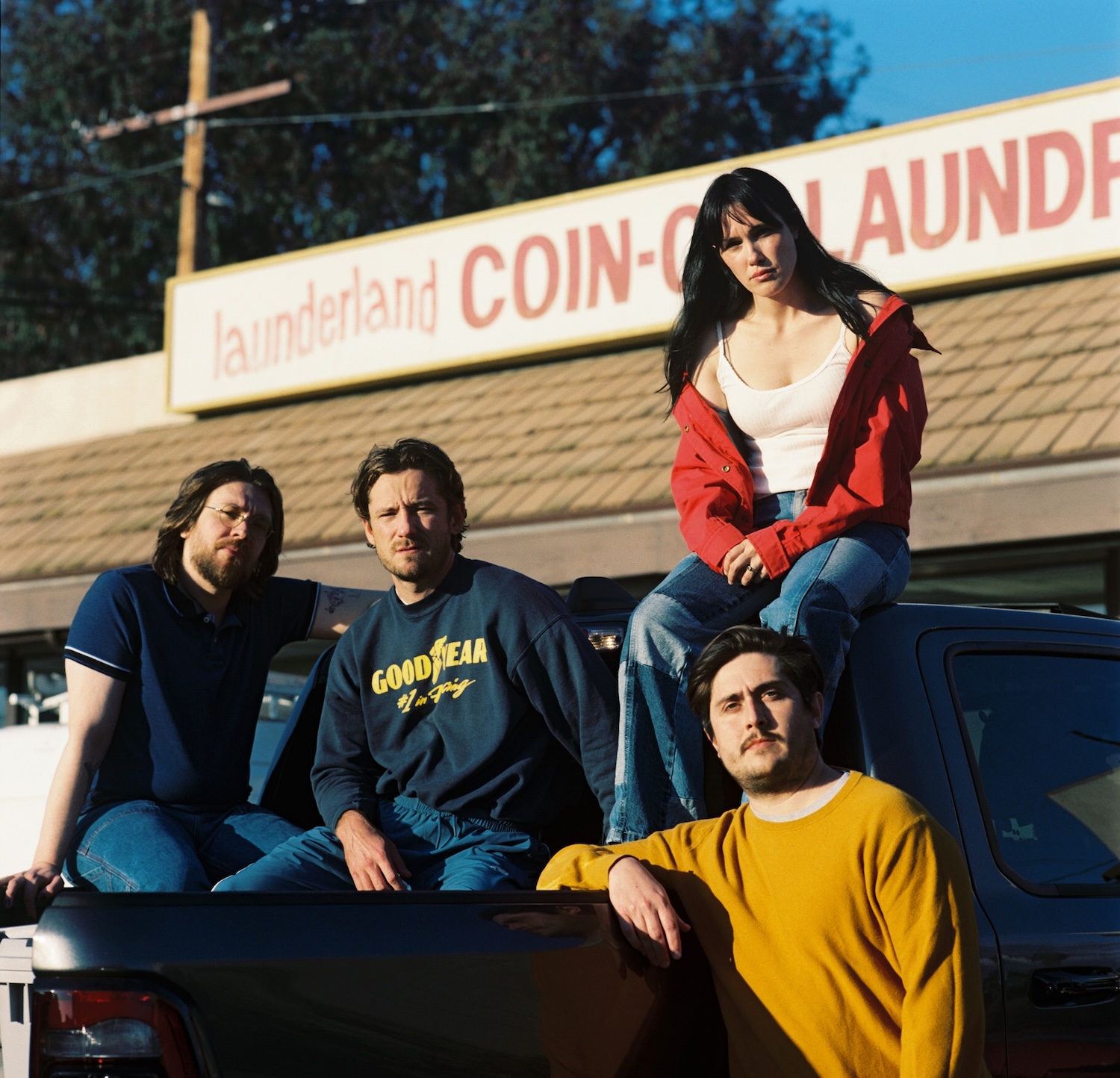
Before long-distance collaboration became cliché in a high-tech, post-pandemic world, Atta Boy had already established the sort of trust that makes it possible. Eden Brolin, Freddy Reish, Dashel Thompson and Lewis Pullman have been making music together since high school. The Los Angeles-bred group’s fourth LP, Silt (Diamond City/Many Hats), is a living document of that shared history. It’s also a testament to patience. Completed from separate corners of the country, the album was built on ideas and encouragement exchanged via FaceTime, shared hard drives and late-night phone calls. Songs were allowed to percolate for weeks or even months. Ultimately, Silt is about the power of connection wherever we can find it. Telephone poles dominate the cover artwork, conversational energy echoes through the lyrics, and songs celebrate that rare friend or family member who’s always there in uncertain times.
With Brolin now based in New York’s Hudson Valley, Thompson in Ohio, and Reish and Lewis holding down the fort in L.A., the group sorted it all out in a recent transmission with MAGNET’s Hobart Rowland.
How did the realities of remote collaboration shape Silt?
Brolin: The songs had all been written and recorded, for the most part, by the time we finally went back to our respective states. But there was a musical exploration that happened when we were re-recording parts and adding on to sort of accentuate the story of each song. Getting to have that time to record embellishments was really a gift because it felt very different than being stranded in a studio for a certain number of hours trying to make something happen. There are still dead ends when you’re trying out ideas remotely, but there’s significantly more freedom and flexibility when you’re on your own and in your comfort space. It’s not that there’s anything better about that than being together in the studio, but I do think it served us well for this record. Because we weren’t all privy to the process of one of us having and executing a certain idea for a song, there was an element of excitement and surprise in it.
“Oh, Mama” is a beautiful tribute to the nurturing power of familial support. What made you want to write about that kind of love?
Brolin: I felt like I owed some kind of ode to my mom. She’s been such a force of unconditional love in my life … I think all the Atta Boy moms have. We were writing some new music in the town where I grew up in central California, and whenever I’m there visiting, I can’t help but remember the many hours she spent with me exploring the outdoors. She really has a knack for seeing the beauty in infinite natural details, so I see her in those when I revisit them. A lot of the song came from just jotting down details in nature that reminded me of her. I walked around trying out melodies, and eventually it came together. That part was actually not too challenging. What was difficult was making it something that would really move her. I wanted it to be her song. I know she would’ve been grateful regardless. But she’s a big classical-music nerd, and I felt like the song needed some grand element like brass in it. I think that elevated it nicely thanks to Dave Nelson, who did an awesome brass arrangement on it.
Silt feels more sonically adventurous than your previous work, with alternate tunings, fuzz guitars, horns and unconventional percussion choices. Were there moments when experimentation fundamentally changed a song?
Reish: We decided to have a mentality of throwing every idea we could think of at a song and either add or subtract from there. The songs never took a hard turn, but sometimes they had to be reeled back. On “Full Cloud,” the drums are doubled throughout, but it didn’t sound right to have the two parts panned completely during the entire song. After lots of messing around, we landed on the drums being panned as two different kits in the left and right and having them blended as one kit on the choruses. The decision process on what stays and what goes is usually collaborative, but everyone tends to have songs they’re more drawn to perfecting individually.
How has that distance ultimately expanded your creative possibilities rather than limiting them? And what does communication mean to Atta Boy in 2026, when we’re more connected than ever but often feel increasingly isolated?
Thompson: It’s forced us to take time to sit with works in progress. We intentionally gave ourselves space to try different things on this album that we haven’t done in the past. I think not being physically in the same location for a bunch of that process let us all come to our own opinions about how the songs were shaping up. Because of the physical distance, time zones, etc., we were sometimes forced to sit with works in progress a lot longer than any of us probably would’ve wanted. But I think that waiting let us develop more interesting ideas than what we would’ve come up with if we were all in the same room at the same time.
I’m incredibly thankful for having collaborators, but more importantly, friends in Eden, Freddy and Lewis. I trust them so deeply and know I can call at any time to talk about anything. Last year was rough for the members of Atta Boy individually. I feel fairly safe in speaking for the band when I say that having an open line between the four of us made things a lot easier. In a lot of ways, this band has always been an excuse for us to continue to be friends after high school, so our connections to one another are very intrinsic to the existence of the band.
What do you hope listeners discover about the band through Silt that they may not have taken away from your earlier LPs?
Atta Boy: A feeling that, even in shitty times, we can grow and evolve and find community, while still acknowledging and respecting that things do feel bad right now.
See Atta Boy live.