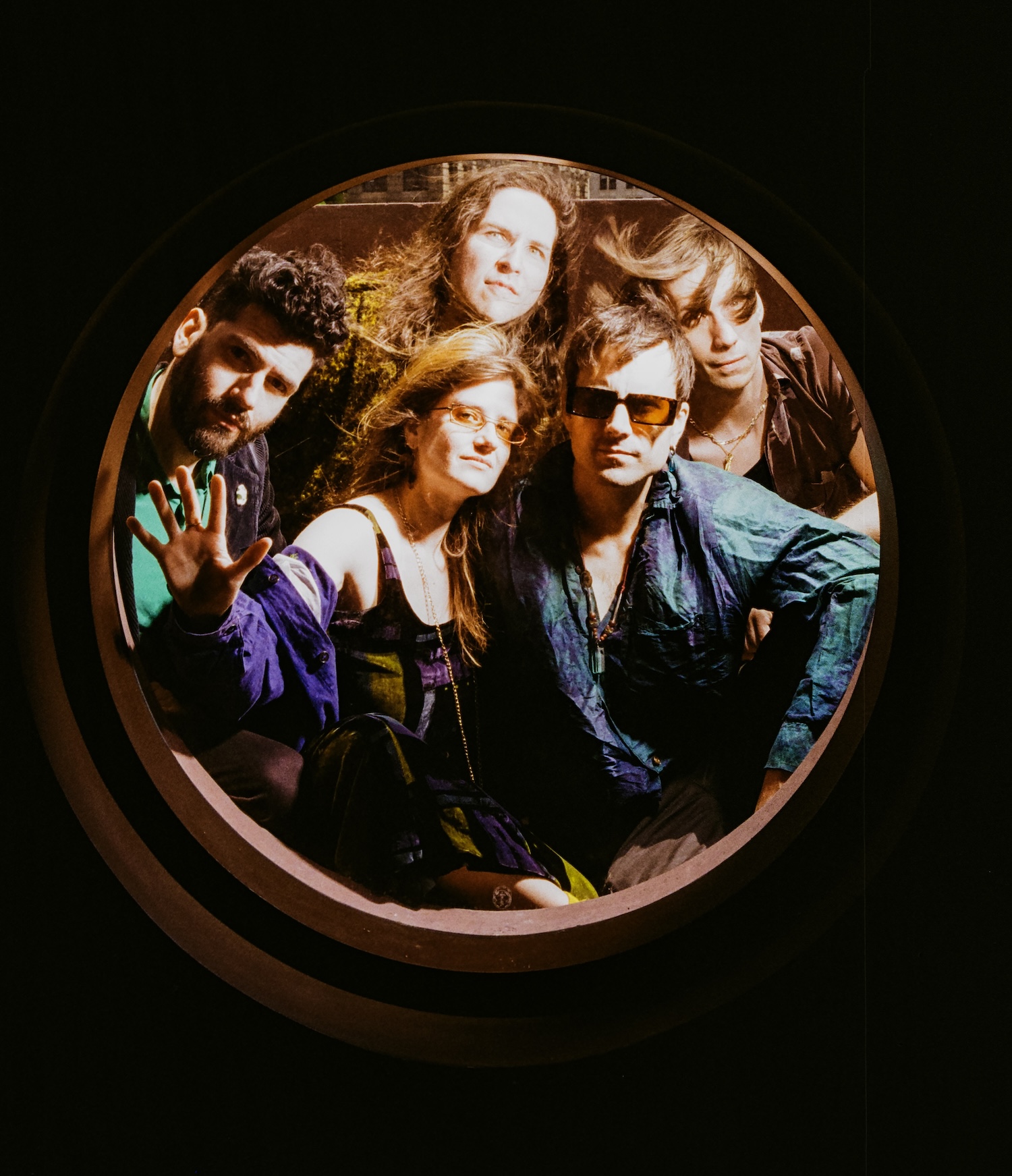
Bodega’s wiry guitars, deadpan vocals and pointed social commentary have earned the New York City outfit a reputation as inspired post-punk revisionists. But singer/guitarist Ben Hozie has always preferred a more fluid description: conceptual rock. On All Inside Aquarium (Chrysalis), that distinction has rarely seemed more relevant. The band’s fourth release trades the angular tension of its earlier work for something warmer, bigger and more melodic—though perhaps not as abominably catchy as 2024’s Our Brand Could Be Yr Life, a brilliant revamp of material from its earlier Bodega Bay incarnation.
Hozie cites the Stone Roses and Jane’s Addiction as reference points for the group’s latest work, even if Bodega retains a restless approach to songwriting and cultural discourse that’s entirely its own. The group even takes on Bob Dylan’s “Slow Train,” reimagining a song from one of the most divisive periods of the rock legend’s career.
MAGNET’s Hobart Rowland got the rundown from Hozie on Bodega’s all-encompassing artistic philosophy, the appeal of Gospel Bob and its outsized connection with British audiences.
While earlier Bodega albums approached politics and contemporary culture fairly head-on, All Inside Aquarium takes a more poetic approach. Why the shift?
I think of our songwriting as fundamentally philosophical. We’re often trying to search for the hidden influences behind everyday thought and behavior. That often involves media, ideology and economics. But it also involves psychology and spirituality. I always think the goal of an artist should be to express all the myriad aspects of their soul. That’s why a songwriter should never stick to one modality. The new tunes were an attempt to express a new kind of Bodega mentality, one that’s no less searching but more interested in the language of dreams.
What did you learn from the overhaul/reclamation project that was 2024’s Our Brand Could Be Yr Life, and how did you apply it to the new music?
The Bodega Bay material is more melodious than a lot of the talk-singing we’ve become known for. Relearning how to sing those songs certainly excited me, and it helped me rediscover a younger, lighthearted version of myself. A melody makes a certain kind of statement even when it’s divorced from lyrics. With Bodega Bay, we often coupled sweet melodies with tough lyrics to evoke a Brechtian contrast. That irreverent sense of play was essential to the Bodega Bay ethos. Today, too much art rock is too one-dimensional and humorless. Poetry without humor is false. Our new songs have a more zoomed-out perspective than the Bodega Bay material, but certainly some of the jovial sonic qualities remain. We never want to be just one type of band. We’d like our music to express a full spectrum of emotions—and lately we tend to be very genre-agnostic.
What attracted you to Bob Dylan’s “Slow Train”?
I personally overlooked Dylan’s gospel period until the pandemic but then fell in love with a lot of his music from that time. His “Slow Train” lyrics—minus the cringey verses we edited out of our version—are absolutely incredible. They’re biblical but also speak to the many secular crises of today, like the collapse of the environment, the rise of anti-intellectualism and the return of right-wing ideology.
The new album was recorded in England instead of New York. How did removing Bodega from its usual environment affect the finished product?
This is the first time we’ve made a record where we got to live together for several weeks, totally immersed in all aspects of the record. We recorded in a deconsecrated church in Leeds called the Nave with producer Matt Peel. The Nave has a very special energy and certainly impacted the spirit and the sonics. The combination of time, space and personnel certainly made this our most alive and detailed recording yet.
How do you account for Bodega’s outsized success overseas, particularly in Britain?
It’s hard to say, but I assume it has to do with the U.K.’s deep relationship with artifice and play in its pop culture. Indie rock in America for the last decade has tended to be without literary irony and more focused on the diaries of confessional solo artists. I see our music as operating in that direct, singing-the-blues American tradition as well, but filtered through the language of a mind obsessed with media and discourse. We call this persona the “cultural consumer.” Like most artists, I feel like we’re misunderstood in our home, but that’s OK. One day we hope to break America.
See Bodega live.