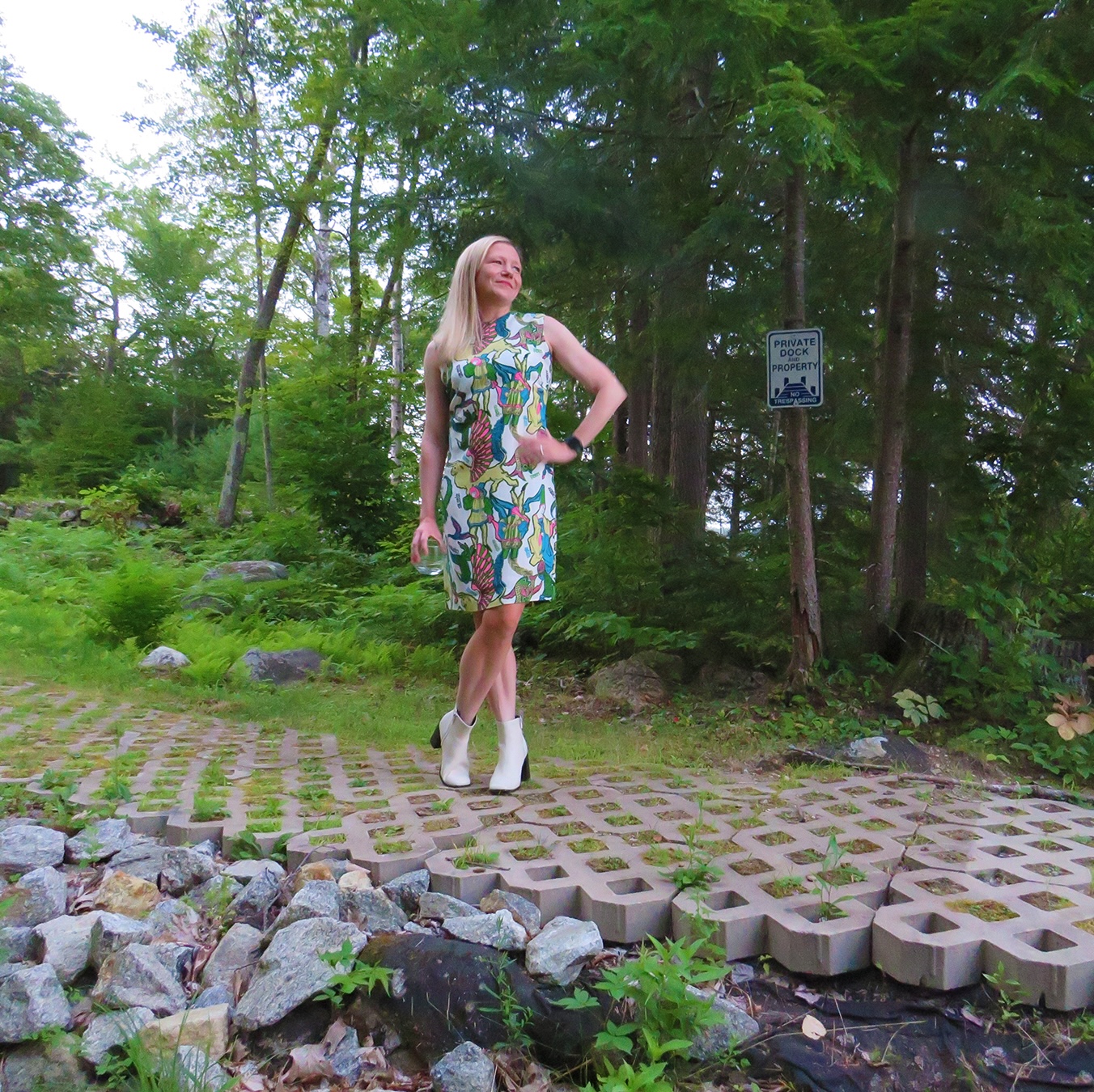
Elizabeth Nelson’s reverence for the great songwriters is written all over the Paranoid Style’s Known Associates, set for release Friday via Bar/None, a durable indie imprint with its own known associations with greatness. As it happens, Nelson is a pretty nifty scribe herself, churning out witty, sharply written copy for everyone from The New Yorker and Oxford American to The Ringer and Golf Digest. She formed the Paranoid Style in Washington, D.C., with husband Timothy Bracy in 2012. The project began as a garage-band romp and has since evolved into an adaptable vehicle for Nelson’s increasingly ambitious forays into a richly woven self-fashioned subculture of music and literary scholarship and fandom.
True to type, the group is named after Richard J. Hofstadter’s influential 1964 Harper’s Magazine essay “The Paranoid Style In American Politics”—and they’ve even drawn dB’s guitarist Peter Holsapple into their orbit. No doubt Holsapple, with his abundant skills as a producer, arranger and player, was instrumental in bending and shaping the band’s current sound to suit Nelson’s astute and unpredictable storytelling. Known Associates’ sonic setting and overall pacing are completely reflective of its mindset. At times, the album sounds like a more extroverted companion piece to Mary Timony’s acclaimed 2024 LP Untame The Tiger—another example of artist, band and producer so utterly on the same page.
MAGNET’s Hobart Rowland checked in with Nelson to find out more about her band’s fifth LP. And just in time for Valentine’s Day, we’re premiering the Paranoid Style’s cover of Lucinda Williams’ “Passionate Kisses,” an outtake from the Known Associates sessions.
Which came first: music or writing? And how has one fed into the other for you?
Music came way before journalism. I’m a classically trained pianist and have been writing songs since I was a teenager. I played in bands all through my 20s and at a certain point decided it was time to front my own band and record my own songs. In the late aughts, I was playing in this band in Brooklyn called Bird Of Youth fronted by my dear friend Beth Wawerna. She’s an amazing songwriter, and I was so inspired by her bravery to have her own band and sing her own songs. I took that leap—and obviously it was very fulfilling. It took a minute to learn the tricks of the recording studio. I recorded a couple EPs with Brian Paulson, a producer I always loved, who became one of my best friends. It was fascinating to watch him work, and I learned a ton. To my great surprise, none other than Robert Christgau wrote some rave reviews of that early stuff, and we were off and running. I still don’t totally know how that happened—it seemed to be magic—but I’ll always be grateful for the early lift he gave the Paranoid Style.
Anyway, my relationship to journalism and cultural criticism was essentially a total accident—or at least something I hadn’t planned on. I encountered one of the editors from Oxford American on Twitter—Jay Jennings, an awesome guy—and he offered me a recurring series of web pieces they were running back then. People seemed to like what I wrote, and I started to get offers from other publications to write about music, culture and golf. I was flattered and it was extra revenue, so I just kind of leaned into it. I’ll always think of myself as a songwriter first, but I like to think these are tools which sharpen one another. I always think of Godard and Truffaut, whose criticism ran alongside their own filmmaking and one informed the other.
How have you managed to round up such a great band? And where does your connection to Bar/None figure into all this?
Well, as far as Peter Holsapple goes, I was and am a great dB’s fan and a great fan of his solo work. He walked into a record store I was working at in Durham (N.C.) for a bit in 2016. I just went up to him and told him I was an enormous admirer and handed him a copy of our second EP, Rock & Roll Just Can’t Recall, which I happened to have on hand. Always carry your own CDs. He was so sweet, and then he played it and liked it. We struck up a friendship, and eventually I was just like, “I need this dude in my band.” So, I just asked. I’ve been fortunate to know many, many fine musicians, but Peter is in his own class as a guitarist, a writer and an arranger. He’s just got one great idea after the next. The rest of the band came together pretty organically. My husband is a really talented player and we live together, so that made sense. Jon Langmead, my drummer, had played with Jennifer O’Connor and Mark Eitzel and this great band Choo Choo La Rouge that more people should know about. He’s the guy I always wanted—he’s such a great, versatile, dynamic player. He’s also an amazing prose writer and wrote an incredible book about the early days of pro wrestling that was published by the University Of Missouri Press. Highly recommended. Michael Venutolo-Mantovani worked in the same record store as me and had fronted an amazing band called the Everymen that I love. He’s a fantastic player with an amazing ear and a ton of ideas. He’s a great songwriter and also writes for the New York Times, National Geographic and a bunch of other places. Large man, large talent. And William Matheny is an amazing guitarist and songwriter—his two solo records are classics. So, yeah, I’m incredibly fortunate to have that group of people around me. They’re so supportive.
As far as Bar/None, my favorite band as a child was They Might Be Giants, and I loved so many of their other acts: the Feelies, Yo La Tengo, Freedy Johnston. They were the first label I thought to send my stuff to when it seemed like the demand was such that I could use a label. Bar/None was the first and only place I sent it to. Luckily, Glenn Morrow loved the band, and we’ve been a juggernaut since.
Quite a few of the songs on Known Associatesare about other musicians and songwriters. On one hand, there’s “Tearing The Ticket,” about D.C. guitar luminaries Danny Gatton and Roy Buchanan. On the other, there’s “Elegant Bachelors,” which you’ve said is about Don Henley. Would you call these songs character studies or something else?
At the risk of splitting rhetorical hairs, I think of “Tearing The Ticket” more as an elegy and “Elegant Bachelors” as a character study. There’s something of a haunted legacy in the DMV area with Gatton and Buchanan—players of such majestic, exhilarating, life-affirming brilliance who came to such tragic ends. It’s hard to reconcile the joy they brought to the world with what the world had in return for them. This business is just a constant heartbreak and not getting any easier. I cried for days about Todd Snider. My god, what a talent. He didn’t deserve that end. “Tearing The Ticket,” for me, is just a small prayer of remembrance—a tiny gesture, just to say I remember, and a reminder to stay true to the things that matter most. We should never be broken by the insane forces arrayed against us as artists, as ethical citizens, as people trying to uphold some semblance of humanity in this brutally cynical time.
“Elegant Bachelors” is at a little more of an emotional remove. Henley’s fascinating. And that work gets more interesting over time. I love “Boys Of Summer.” It’s an objective masterpiece—but what kind of masterpiece? That was sort of the jumping off point for me. What does his critique look like projected 40 years into the future? I wrote a piece about it in Southwest Review, where I called it “the first stirrings of the angry investor class.” That’s one of America’s great current paradoxes: Why does it seem like the absolute winners of our grinding techno-feudal nightmare are so fucking angry? It’s like, building their 20th garage didn’t scratch whatever itch they have, so they have to get rid of food stamps in order to feel better. It’s a strange, sick corruption, premised on inflicting pain through economic disparity. It’s completely psychotic. And Henley arguably saw it more clearly than any of his peers.
Tell us about your long-running passion for Lucinda Williams. What do you think of her new LP?
Oh wow—that’s an immense question. I guess I heard Lucinda Williams first in my early 20s, when I was trying to find my footing as a singer and songwriter. I heard Car Wheels first, and, of course, that was like having a million doors blown open in my mind. Sometimes when you’re young and trying to locate just who you are, someone is a beacon, and she was that for me. I liked the way she looked; I liked the way she talked; and obviously, I was in awe of her writing and singing. I won’t deny that sometimes my emulation might have veered into imitation, but that’s the way this stuff works sometimes. You can go through others to become who you are.
I reviewed her awesome memoir for The Wall Street Journal, and there’s this anecdote where she is being produced by Steve Earle—whom I also love—but she wasn’t happy with a vocal take and kept on wanting to redo it until she found the ineffable thing she was looking for. Earle was getting frustrated, thinking he had lots of great takes, and, eventually, they had a big argument about this. And Lu was basically like, “If Bruce Springsteen wants to sing 400 takes, he’s an uncompromising genius. If I want to do that, I’m just a woman acting insane.”
And that’s the thing I’d tell the up-and-coming ladies to be aware of. Even a lot of well-intentioned dudes are going to try and make you feel like you’re being difficult for simply standing up for yourself. You’ll be second guessed constantly. You’ll have to quiet those voices in your mind. There’s a lyric in “Tearing The Ticket” that goes: “They told me I’d never make it/I told them where to stick it.” That’s straight Lu. If they don’t believe, then fuck ’em.
Her new record is amazing, brave, funny, strident and overall galvanizing and rad. I wouldn’t be anywhere in this world without her.
We’re proud to premiere the Paranoid Style’s cover of Lucinda Williams’ “Passionate Kisses.” Check it out: