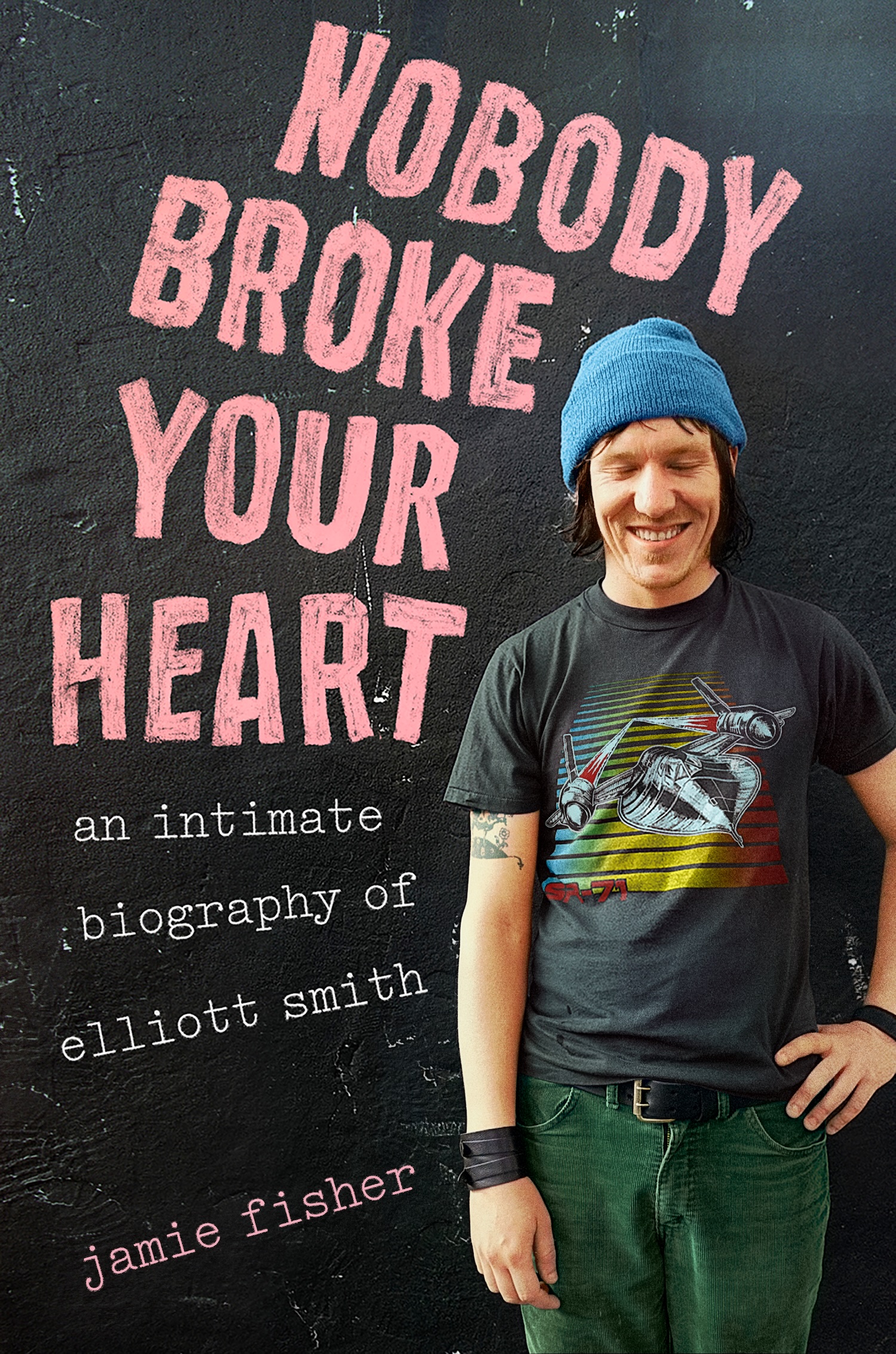

On the 23rd anniversary of Elliott Smith’s death, MAGNET’s Corey duBrowa speaks to Jamie Fisher, author of the new, definitive Smith biography Nobody Broke Your Heart (Dutton).
Portland, Ore., resident Jamie Fisher came by her signature project honestly enough. As a fact-checker/researcher forNew York Times Magazine for more than a decade, a pandemic-era discovery of (and then fixation with) Elliott Smith’s music yielded precious little insight into his tragic passing and even less in terms of authoritative written documents: Benjamin Nugent’s 2004 book Elliott Smith And The Big Nothing was fine but economical and rushed, while William Todd Schultz’s2013 book Torment Saint was thinly reported (the title itself is a mishearing of a Smith lyric) and given to way too much uninformed speculation. Even Autumnde Wilde’s terrific 2007 book Elliott Smith (now out of print, occasionally fetching wild prices in the secondary market) was essentially a photo and interview collection as opposed to a traditional narrative biography.
So Fisher did what her day gig had trained her to do so well: She spent four years and 140 interviews digging into Smith’s backstory and notoriously tight and protective inner and family circles to produce a biography, Nobody Broke Your Heart, that is both definitive and compulsively readable and entertaining. And in the process, Fisher has done what was seemingly impossible before: transforming the Smith narrative (he was gifted but depressed and addicted; doomed and suicidal with songs that eerily foretold his early end) into something far more complex, human and real.
Fisher agreed to a lengthy sit-down and held little back in terms of her experience reporting the book and her encounters with Smith’s family, friends and romantic interests. Best of all, Fisher spent a great deal of the conversation (just as she does in the book) focusing on Smith’s true love and life’s obsession: music, both his own and that of the artists who influenced him and came to inform his considerable body of work.
On the 23rd anniversary of Smith’s passing, we remind ourselves of just what a dent in the universe Smith left when he bid his fond farewell back in the early 2000s.
Congratulations on the book. It must feel like a pretty monumental achievement for it to finally be done.I thought I’d start at thebeginning and ask about your gateway to Elliott. How did you discover him in the first place, his music, and how did you determine ifthere wasa story about him that hadn’t been told yet? So much has been published about Elliott, for better or worse.
I actually didn’t discover his music until about 10 years ago, when Seth Avett and Jessica LeaMayfield came out with their covers album.Itwas featured on an NPR podcast. I was listening—walkinghome from work to the subway—and just like, “Wow, what is this?” And so for a long time after that,I was just listening to that album and then gradually migrated to the actual, unmediated Elliott. And then during the pandemic, there was that period when we had so much empty time because the commute was gone. And so I’d walk around Prospect Park in the afternoons justlistening to music. And I started listening to Elliott more and more because there’s so much to explore; he’s one of those artists who really rewards repeat listening. I got to a point where I had gone deep into the bootleg recordings, the unreleased music that had been leaked. I thought I should really check out abiography.And I looked at what was out there, and I realized that the person I knew from the bootlegs and from just listening to his music—from his stage patter to just the way that he wrote songs and his delivery—was not really captured in a biography.I could see already that there was this missing piece. And when you look at Ben Nugent’s 2004 book,he literally was writing that in the months after Elliott died and trying to get it out in time for the release of From A Basement On The Hill. People were not ready to talk. I mean, people were barely ready to talk to me in many cases.
I want to talk about that because I feel like it’s an amazing human trick that you were able to break into such a tight circle that is so notoriously difficult. I mean, I know some of these people from way back when we were all in Portland together 3o years ago, and it’s still hard to penetrate. Feelings are still raw. Resentments are still real.
Absolutely.And then, generally speaking, if you look at the books about him, you might get like 12 people listed as sources in the back and then six of them who actually knew him well. Like if you look at William Todd Schultz’s book, Torment Saint,forthe chapter on Elliott at Hampshire College, it’d be like he talked to someone who also went to Hampshire—not even someone who knew Elliott, just someone who was a contemporary.So I just thought: There hadto be more people to talk to. And I also felt like the books that were out there were not—with the exception of something like Matt LeMay’s 33 1/3 book (about Smith’s major-label debut, XO)—generally that interested in his music or process. And I thought that was strange. But I’d initially thought about the book as more of a thematic exploration of his life through his lyrics. So, for example, there might be a chapter called “Pitseleh,” which exploreshis relationships and also essaying the themes in his love songs. Because I had thought so much about his lyrics by that point, and I knew that a lot of people were just incorrect or puzzled about them. If you look at Schultz’s book,a lot of his analysis of the lyrics, he’s like, “It’s confusing.” And I thought, oh, it’s not that confusing. You just have to think about it a little bit more. Schultz wrote that “Needle In The Hay” was about a 600-pound wrestler named Haystacks Calhoun because it contains the word haystack. [Laughs]

That’s not it, chief. In fact, there’s a haystack pendant—charm, around the neck—that’s a significant part of the cluetrain on that. Aside from the needle/drugs reference, which is also pretty obvious.
Maybe more likely to be about Haystack Rock (a formation near Cannon Beach on the Oregon Coast, where Smith took photos early in his career) than this wrestler.
Elliott started out being much more specific. There was, I think, some intention, particularly later in his career, to obscure things. It ended up being a picture that loses gradation. Hisso-called “little pictures made out of words” would pixelate after a while.
That’s it, absolutely.And probably most dramatically on Figure 8 in terms of that process. But in any case, the point where I knew that I would have to do something more is where people had really started talking to me who hadn’t talked before. And then I thought, “Oh, I have an obligation here.” And I especially realized this was trueonce Rachel, his half-sister on the Smith side, had talked to me. That was like, “Oh, OK, so I have to do this.” But if I knew how much work it was going to be, I wouldn’t have tried to do it. Not because I don’t want to work hard, but because I would have thought I was notphysically capable.
This totallySisyphean task. Themore you uncover, the less clear the story becomes. I feel like there are a lot of misconceptions out there about Elliott that your book seeks to correct to some extent?
Early on, I started to think about it as like a parabola where the more you knew, the more you felt like you knew him. And then the more you knew, you just felt like you’re falling further and further away. It’sthisconstant negotiation. And of course, some of the stuff that I thought I knew about him just turned out to be wrong. One example is thatI had imagined that I understood what his time in high school was like, from what I’d read. And then you talk to people like Garrick (Duckler, his high school friend and bandmate in Stranger Than Fiction and A Murder of Crows) and his friend Jason (Hornick, who also played with Smith in Stranger Than Fiction), and you talk more to Tony (Lash, high school friend and eventual bandmate in Heatmiser) and you realizeyour assumptions were wrong. It turns out that high school was not a lonely time for Elliott. It was a time of this really intense, sweet friendship. And it was funny to me because I could very easily imagine it. As an author we go in and are wedded to what we already come in with, and then we can’t let go of the outline.I had to let go of the feeling that I actually understood.
So by the end of the book, there are a lot of untrustworthy narrators roaming around the manuscript. Maybe most of all, Elliott himself. His life was really confusing, especially how it ended.
I mean, the last thing I ever wanted to do was to pretend I knew something I didn’t.There’s this Chekhov quote that I found when I was working on this book. I had this file where I was just putting things that reminded me of Elliott: “A psychologist should not pretend to understand what he does not understand. Moreover, a psychologist should not convey the impression that he understands what no one understands. We shall not play the charlatan, and we will declare frankly that nothing is clear in this world. Only fools and charlatans know and understand everything.”
What I really appreciated about how you wrote and reported Nobody Broke Your Heart is that you don’t hide yourself in here; you’re present, you show up in your own story. It’s not always in the most flattering light, either. You take pains to point out that you’re uncomfortable, that your subject is being squirrelly, that people are contradicting each other and it’s confusing at best to sort through the mess that Elliott left behind after he died.
That’s a good way of putting it. My perspective is neutral, but I’m in there. And part of the reason for doing that is because it felt like a fair trade because people are being so vulnerable with me. Whoam I to insulate myself?
I appreciate that as a writer. The idea that there is one story, many perspectives—the Rashomoneffect. I mean, your book even includes some discarded album artwork that offers a prismatic view. That felt very symbolic or emblematic to me. Here’s this artwork that didn’t make the final cut for an Elliott album that nevertheless perfectly encapsulates the journey of learning about his life and work.
I was so glad that Neil (Gust, Elliott’s college friend and former Heatmiser bandmate)connected me with that photographer, John Clark. Neil allowed me to look at all of these images. When I went to Neil’s apartment in Williamsburg, he has hisbedroom and then he has a guest room. And in the guest room, not hung, but set facing backward against the wall, is one of the framed photos that was part of this larger kaleidoscope. And hetook it out and he showed it to me. And much later I asked if I could include it in the book, and Neil connected me with John, who gave me access to dozens and dozens of different kaleidoscopic images that were made like this. They were all beautiful,and some even referenced the moon in really lovely ways, but they were used to make this composite image that no longer exists.
So is it fair to say that as you’re reporting, the layersof the onion are starting to be peeled away and you’re getting deeper into it. And that maybe you’re having this “oh shit” moment, like this is a different book than you started with?
I wanted this initially to be a thematic exploration of the lyrics. And then I realized I had this obligation to make something bigger. And that was scary. The interesting thing is that it was never a situation wherepeople would talk to me and then they’d say, “I had a good experience talking with you, and here’s some other people you could contact.” It was almost never like that. People are really protective of Elliott, but they’re also protective of each other. So it could be this very long process. Other times, people would send me an emailaddress and be like, “Don’t tell her it came from me.”

“This is just our little secret.” Larry Crane (Smith family musical archivist and Smith’s friend/producer) is one of the few who would tell me when I was writing about Elliott, “You can use my name to talk to this person—I’m the one who sent you.” For the most part, it was always a big scavenger huntor me going through my friends list. You’re really sorting through a lot of broken pieces.
One of my big misconceptions going in was that there would be this “central hub” where I would get through to someone, and then I would be able to connect to other people. And in fact, it was just this years-long process of trying to find people and then helping them feel comfortable, but also not following up so much that they felt annoyed, either.
You quote Neil in the book who is talking with one of Elliott’s siblings—Rachel, maybe—where he says, “Don’t let them make him a cartoon,” after Elliott passed. And bythe time you get to the end of the book, I feel like you’ve delivered on that. He’s not a cartoon; he’s human. So there are moments that are charming. There are moments that are funny. Honestly, for as much as I feel like I know about Elliott, I never understood why “Ostriches And Chirping” was on the last album until you wrote in the book: Hey, this is who he was, too. So I love that your book delivers a more fully rounded, complicated picture of Elliott. Was there anything about him that surprised you? Like, if I had known him, I wouldn’t have thought this would be true?
Thereare all kinds of ordinary surprises that happen when you’re learning about someone’s life. Like one of the details that was really sweet to me—but also surprising—was that he loved classic literature. Sean Croghan (Smith’s friend and roommate and Crackerbash frontman) told me that he would try to get Elliott to read modern stuff like Cormac McCarthy, but he just couldn’t bebothered with it. He’s like, “Nope, there’s so much good stuff that was written 150 years ago. I don’t have time for it.” And at the same time, Molly Vogt, who was his roommate and worked with him at Le Panier bakery, remembered that at one point she was reading the novelization of Top Gun. Shetold Elliott about this, and he was just fucking delighted, you know? Heappreciated sincerity, people loving something, not because someone told them they should love it, just coming at it with their whole heart.And he wasn’t snobbish that way, except for himself, with hisidea that, “Now I need to be reading Balzac, and I can’t possibly be reading Cormac McCarthy.”
It’s pretty common knowledge that he could kill a Scorpions cover in karaoke. At first, you’re like, “That’s got to be ironic.” But he really did love this music, and in Texas, I think he likely heard a lot of it.
That’s there, too. Or that he’d play Elton John so much on the tour bus that it ended up being banned.
You know, hearing you say this now, you’ve helped me complete the circle because there’s a big part of your book that’s a write-around in a very classic sense. Like Gay Talese’s “Frank Sinatra Has A Cold,” where the subject isn’t here to comment, but everyone else is.
Right. He’s both not alive, and he’s absent. He’s absent in the way that he also was absent during his life. And so, you know, there’s an extent to which if I’d written this while he was alive, the book would not be different.I did a book event last week with (author) Lydia Kiesling, and she pointed out that as she read the book, she was struck by how many people were blaming other people or blaming themselves rather than needing to blame Elliott.I think that’s both very human but also very particular to Elliott. Like, no one wants it to be Elliott’s fault.
But I’m not sure that you really shied away from that, becausethe epilogue to your book is a way of completing that little prayer circle. It’s like Elliott’s at the center and there’s all these people around him and there’s little shards of reflected memory. So the mirror—of him—is broken.Let’s talk for a minute about the music, because I think one thing that you did super well is you helped chart a course through his catalog, especially what remains unreleased. I mean, the Reddit community is insane. Literally,it’s all these kids, creating a master list: “Place Pigalle,” “Stickman,” “Dancing On The Highway.” Even just a casual tour through it yields about 30 songs of amazing music that was never officially released. And I feel like you putthat in place, and in fact, there were people that it connected to who were not that well known. Like hiswhole French situation.
“The French Situation” is a good title for a movie. Ha.
Well, it feels like a movie about him, but also the fact that all of these women in his life knew about one another. On the one hand, you think, “Of course they did,” but I had never really pondered before that Joanna Bolme and Amity (whose last name is never revealed, but Smith’s XO song is named for her) and this French girlBéatriceand Valerie Deerin and Jennifer Chiba were all connected through Elliott, and you linked these relationships to song in a way I hadn’t quite put together before.
Interesting. I mean, these songs aren’t literal. They’re not all literally true, but they are personal. It’s a mistake to approach it as a one-to-one codex situation, but there is something to be gained by thinkingabout where the songs come from and the people that they’re associated with. In the same way that there’s something to be gained by doing a biography where the people aren’t talking heads, you know—they’re real people where thereader and the writer areinterested in their lives as full people. It was so interesting to get to talk to some of the people who inspired these songs. We’re talking about these women, but we’re also talking about Josh (Deutsch), who inspired “Independence Day.” OrTammy Watson (frontwoman for Kill Sybil, who toured with Heatmiser), who inspired “Good To Go” and described it as Vaseline being smeared on the lens—not an exact portrait of her, but her spirit is there. That tells you something about Elliott, too—part of the canvas he was using was theirs, but not the whole of the canvas. Like I know the nickname “Pitseleh” was JJ’s (Gonson, Elliott’s former girlfriend and manager), and I was surprised when I talked to her because I couldn’t find someone who had ever talked with her about that song before.I didn’t know her feelings about the song at all. So when she said her first reaction was rage, I was like, “Oh my gosh, really?” And then I understood her perspective, but it was really funny because it is such atender song that’s so beloved.

Well you really did unearth a lot of new things. Larry Crane had told me the “Pitseleh”story before,but it’s not like it’s written down anywhere. And then there are things that are just flat out brand new. Like youranecdote about Beck’s yoga space backstage on his tour; I just about died because it’s a really funny,very “Beck” anecdote where Elliott just happens to wander into the frame. I had a bunch of “oh shit” moments throughout this book, and I thought I knew a lot about Elliott’s life.
It’sreally funny because I’ve been posting about some of the things that I’ve learned from reporting the book or just some of the new photos, because I want people to understand this isn’t just rehashing what’s out there. I never wanted this to be the kind of book where I was like, “Well, I could have just read the Wikipedia page.”
There’s also a fair bit of conflict in your findings. I know I wrote in MAGNET back around the time of Elliott’s passing that I rued the fact that no more Elliott music would ever be created, that—like Johnny Rotten once said from stage—I felt cheated. So for as much as I loved his music, his passing had kind of ruined some of it.
Yes, exactly.I think that with a lot of artists who die young, there is that tension that people can feel where it’s this kind of confused impulse—like, I want him to be around because I want more music, and trying to separate those feelings out.I remember Garrick telling me, “I must be the only person in the world who wishes he never played music.”And I said, I don’t think you’re the only one.
For sure he’s not the only one. Even Larry has soundedlike he’s very conflicted about that—I think he knew when they recorded “Miss Misery” that trouble was coming. “This is the worst possible thing that could have happened to him,” a signature song that would become popular. Good Will Hunting changed his career. And, of course, Elliott wanted that, he was seeking success. But again, I feel like your book captured these dichotomies—even down to Elliott’s album titles being a series of things in opposition to each other: XO, Either/Or, Figure 8, From A Basement On The Hill. From the time I first started talking to people who were close to him, it was pretty clear to me that there is nothing that wasn’t oppositional or conflicted about Elliott. He is putting private thoughts in a very public place; he’s doing a very angry thing in a very quiet way.
Wellone of the things that was interesting to me is how people are so protective of him. (Journalist/radio host) Jenny Eliscu was sharing something with me, saying, “I don’t think he would have wanted these (papers) shared. I’ll read them to you over the phone but you can’t quote them.” And she started reading them, and I’m like, “But, Jenny, he read this out loud at a show.”I totally understand the impulse. And at the same time, it’s interesting because he was both so private and not private at all.
I mean, at the time, in the ’90s, it wouldn’t have been cool to admit you wanted success. But he absolutely did.
Whenyou talk about surprises in the book, I think that was one of the genuine surprises for me. Because he would pretend—as I think a lot of indie artists do—that it was entirely about the art. And of course, he was incredibly focused on the art, but it was not completely divorced from the reception of the art. He wanted to be heard. I talked with Matt Smith, who goes by Matt “Money” Smith, which is kind of funny because he was like, “I feel conflicted about the nickname ‘Money,’” but he was a wonderful guy. And he used to be in charge of radio outreach at DreamWorks, especially for the alternative stations. And he remembered Elliott saying, “I think it would be so cool to get ‘Miss Misery’ played on KROQ,” and most people just don’t think of Elliott as being commercially savvy or even that interested. But he did care about the reception. He wanted people to hear it. Just like I want people to read this book!
By the same measure, for wanting the success, he clearly had a control thing going on. If you’ve got a minimum of 30 amazing songs that never made it onto an official album release—not to mention what Larry did later with New Moon, which unearthed a bunch of unheard material from early in his career—you’ve definitely got some control issues. I mean,if Elliott could go up on Reddit now and see the kind of shit that people talk about on a daily basis, he would be like, “The music’s not really mine anymore.” And look, that’s OK—as a fan, you’re allowed to interpret things and I feel like that’s what people are left to do now with all of this unreleased music.
Maybe he had afear of it taking off and becoming something that he never wanted it to be, but there’s also the fear of it not taking off. And it’s like, “God, which one’s worse?”
Speaking of the art-versus-commerce thing—are you happy with the book’s reception so far, commercially and critically?
Yes. It went to the bestseller list in the first week, like, you know, USA Today bestseller. So it had a lot of initial momentum. And I hope people keep finding it. It’s been interesting because there’sbeen this weird shut-out where the major outlets haven’t been covering it at all. And I think part of that speaks to the state of book criticism right now. That’s been a bit sad to me. I mean,I reviewed books for so many years. It’s something that I did for a long time, and I’m sure I’ll do again. And there’s just a certain pleasure in having someone who reads for a living read your work and then tell you what they think it’s about, which is always interesting, right?
Was there someone you met over the course of your reporting where you were like, “I love this person. I just want to hang out with them.”
Chris Rage was such a fucking delight to talk to. He also made my head hurt because he went in so many directions at once. And I remember after I talked to him feeling like, “I’m not entirely sure what just happened, but I’m sure I’ll understand when I write the transcript up.” He was so sweet and kind. I alsolove Garrick.Béatriceand Garrick were the two people who justpreferred email correspondence for a variety of reasons. Mostly you can just collect your thoughts a lot more easily that way. And so I have novels worth of correspondence with them.
To that end, you must have enough cutting-room-floor material for a whole other book?
Yeah. In terms of structure, one of the things that I would do for each chapter was collect all of the interview passages that might be relevant to that chapter into one file. So it might be everything that’s relevant to the first half of 1999 in one file. And the chapters were supposed to be10,000 to 15,000 words. And so I would put the interview stuff itself in one file, just the relevant stuff for the first half of 1999, and it would end up being 60,000 to 80,000 words. And even if I cut that down to 15,000 words, the book can’t just be people talking.
Right, you made the decision not to make it an oral history.
I mean, those are great, butnot what I wanted to do because I wanted to be able to analyze the music, among other things. So a couple of years into this, I started thinking what would be really great would be to—if there’s not some conflicting issue with the publisher—do a follow-up e-book because there’s no overhead. It would just be some of these additional stories.
Yes, please. Can I just put my hand up now to buy that?
Sothere was this photo I took when I visited Marc Swanson (Smith’s longtime friend, starting at Hampshire College) inupstate New York. We were going through photos in his office, and I took this photo of one of the film strips from when he was on the XO tour. And afterward, I thought, “This would be an amazing cover.” And, you know, the publisher was not as sold on it as I was. [Laughs] But both Marc and I were like, “This is amazing.” So if I’m able to do this b-sides book, we’re going to use this on the cover; it’s a really lovely picture where Elliott is reaching for a guitar on the couch, and the guitar is in the center of the image—literally, the music is the center. Elliott’s blurred but smiling, which I think says a lot about him, right? Marc said, “Elliott would have loved this.”Chris Chandler was one of Elliott’s producers in the Basement era. He’s the loveliest guy but extremely technology-challenged. He had some recordings he wanted to send me and was asking for instructions on how email worked. [Laughs]
I am admittedly curious how you got some of these people—who had refused to participate in anything else about Elliott that had been published previously—to speak with you. Many of the members of his family had never gone on the record about anything Elliott related. Was this a stringball that picked up momentum? How did it come to pass that so many people who had told writers “no” before somehow participated in your book?
Well, forcontext for people who may not be familiar, it’s hard to convey just how difficult it is to get people who really knew and loved him to talk about Elliott.I remember when Justin Townes Earle died, there was a piece about him almost immediately, like this amazing oral history in Rolling Stone.And I remember looking at it back then and being like, “It’s crazy that people are ready to talk.”Because here’s my context: I didn’t think of myself as someone who was seriously immersed in “Elliott world” at that point. And it seems crazy that these people were willing to talk given that it’s 15, 20 years later and people are still not ready to talk about Elliott. So it was less of a ball of string that gathered momentum and more like constantly pushing a rock up a hill.
I mean, I may know more about the dynamics than most readers, but some of these people aren’t even consistently in touch with each other, you know?
It’s funny, because Larry told me early on thatpeople tended to use him as a hub because he’s talking to a lot of people who are often mad at each other. [Laughs]
And often that anger has nothing whatsoever to do with Elliott. I know Janet (Weiss, Smith friend, former Sleater-Kinney drummer and part of the duo Quasi, with whom Smith recorded and toured throughout his career) independently of all this. Same with Corin (Tucker), with Carrie (Brownstein). I was living in Portland when Sleater was a going thing. I wrote about the band, I did interviews, went to shows. Anyway, I reached out to Sam (Coomes, Smith’s friend, former bass player in Heatmiser and the other half of Quasi) for the book I’m publishing next year about Portland’s most definitive 12 songs—Twelve Tunes From Urban Bohemia—and he passed on participating despite the fact that he and I know each other pretty well, too. He basically said, “I’ll let you figure out with the Sleater ladies if any of them are up to having a conversation,” and one by one, everyone tapped out. I think when Janet was fired from Sleater-Kinney, a bunch of relationships frayed. It just ripped through that little community and cleaved it into camps. It’s what happens in small scenes. I suppose if we were writing about people in Seattle, all these years after Kurt passed, or Chris Cornell or Andy Wood or Layne Staley, you’d still be hearing stuff like, “That person was so-and-so’s dealer.” Or, “I can’t be seen talking with them.” Or whatever. There’s just all of this residual trauma and drama.
Well,there were even some people I talked to for the book who told me, “I’m not going to talk to you if you’re talking to this person and that person.” And in some cases it was because they felt that this person or that person was not good for Elliott.Which I can understand, but the question becomes whether it’s only the people who were good for Elliott who should be in a book about him. So there are all of these crossed wires; itwas all really sensitive.After the explosion of everything where I had finished editing and re-editing and arguing with this really strange copy editor and the book was finally finished and I could not change it anymore, I was finally able to slow down and reflect on howstrange and wonderful it was that so many people talked to me. And I don’t really know how to explain it. I remember my first conversation with Ashley (Welch, Elliott’s half-sister), I was fully aware by that point how difficult it was to get people to talk. And I said, “I wish there was some purity-of-heart test, where you could determine if people have the right intentions. Like, ‘Can you recite all the lyrics to “Angeles”?’” [Laughs]And she said, “I don’t think I can recite all the lyrics to ‘Angeles.’” Sothere’s no easy signal. I remember when I was finally able to talk with Rob Schnapf (Smith’s producer) and Margaret Mittleman (Schnapf’s wife and former Smith manager), which was wonderful. You know, we met in Silver Lake, and I got up at one point and left my recorder on the table. And when I went back later and was transcribing the interview, Rob had said on the tape, “This is amazing. She remembers this stuff better than me.” [Laughs] So maybe part of getting folks to talk is just doing your homework and the purity of heart you really can’t signal through any easy means. There’s no rote way to telegraph it, no way to fake it.

The elephant in the room with Elliott has always been his death: the circumstances of it, how police handled it, the toxicology tests that suggested no illegal drugs or alcohol in his system but that antidepressants and ADHD meds as prescribed were present, the coroner’s unclear verdict (“undetermined,” meaning that the L.A. County Coroner could not determine if his death was self-inflicted or the result of homicide). Can you give a sense of how you approached all of this and how it affected what you wrote?
Yeah, the last quarter of the book was the hardest to write because it was that era of Elliott’s life. And even if you are not trying to go in and cover it in a sensational way, if you reach a certain level of detail with it, it ends up being sensational. And it ends up being too much.And in my initial draft, the main difference between that and the final version of the book is that that last quarter of the book got shorter, in partbecause it just becomes so grim and you don’t want the reader to give up. But also partly because you start asking yourself, “What do I have the right to see? What do I have the right to talk about?” I don’t want to enable someone else’s voyeurism.There’s a biography that came out a few years ago—I think only in the U.K.; I’m not sure that it ever reached the US—but there’s some stories in there about the last years of Elliott’s life that I thought were really irresponsible to share.And I was just gutted reading them. SoI just felt like there’s a certain level of granular detail that you don’t need to get into. You need to get into enough that you’re honest to the experience of his suffering. It’sa very hard line to walk. And so I ultimately ended up paring it back—in some cases being broader about that period, and in some cases just focusing more granularly on the music in that period or his work on the studio (New Monkey, so called because Smith’s obsession with equipment and repair had become a “new monkey” on his back).
I had read—even before your book—about Elliott’s fixation on his recording studio, withreally expensive gear that was broken, and in a weirdly therapeutic way, he was focused on trying to rescue the gear. But the stuff that I personally ended up with as an owner—his guitar was busted, that amp was a mess and needed serious repair work. And I got it from JJ (Gonson)’s sister in Brooklyn, who didn’t care and basically just wanted it outof her house. [Laughs] So it’sinteresting that he and many of the people around him were pretty unsentimental about that stuff. And yet, as you pointed out in the book, after he passed, his family very quickly drew the shades and kept much of the equipment, his music. So in the end, maybe it does have value that he never assigned to it while he was alive. To him, the gear was just tools. To them, it’smemories—it’s Elliott.
So just tobe fair—to clarify for people who haven’t read the book—this gear was broken when he got it for New Monkey. He was ordering a bunch of busted gear off eBay, which is really funny because there’s this draft of his song “Stickman”that’s just written on the back of a piece of paper that reads, “Success, your eBay bid for this microphone for $80 has gone through,”a document of that time. Like a lot of his writing, it was just on the back of whatever was around, whether that was a contract for DreamWorks or whether it was this scrap of paper on a bid.
That’s my draft—the one I had framed! Literally the one that has the words “Fuck Me!” scrawled down the side of the song. It’s handwritten on the back of an eBay bid.
Well, funny enough, I wasable to find the guy it was written to because I was curious if they had a relationship where Elliott was consistently buying gear from him. And I mentioned, “Hey, do you remember selling this $80 mic to Elliott Smith?” And he’s like, “Oh my God, I had no fucking idea that was Elliott Smith.” So theydidn’t have a relationship, but that’s a good example of the kind of rabbit holes I would go down, which sometimes panned out, but sometimes did not. And there was this period where Elliott was blocked and could not write because of everything that he was taking, but he was really invested in trying to rehab this broken-down recording equipment, which you can definitely read as a kind of metaphor. But yeah, the studio was a mess, and it was meaningful work for him. And at the same time, I asked Luke Wood, his old A&R executive, if he ever went to New Monkey, and he said he did. So I said, “What was it like?” From Luke’s end, it was just like a horror story because he could see how much work it was going to take and how it was ultimately goingto prevent Elliott from doing the thing that he was best at and what he enjoyed doing and what really brought life to him, which was working on music. I mean, Elliott’sfamily had offered Larry (Crane) the studio.And I think logistically, the main question Larry had was how on earth was he supposed to simultaneously run studios in L.A. and (Jackpot!) in Portland.I did a Q&A with Larry that was great, for the book launch, but he pointed out that one of the most amazingthings about New Monkey just still being around is that it was not intended as a commercial studio. Elliott recorded musicians there, but you go in, and it really is just a small space. It feels very intimate, like someone’s living room. And the fact that they’ve been able to keep it going is really a miracle. In the book,I talk about Elliott sleeping on the couch; I just pictured a normal-sized couch, and you know, it’s not even a full-sized couch, just this tiny little couch next to the mini fridge. A very small space.
Have the Elliott truthers or conspiracy theorists wanted you to change anything? Maybe they read the book and said, “Hey this doesn’t conform to my conspiracy theories.” So they’re somehow trying to get in your head and change your view of how it should have ended or how it’s depicted.
I don’t trawl Reddit and other spaces like Goodreads and Amazon looking for what people are saying. So I mostly end up engaging with readers when they write to me or they comment or they tag me in a post. And that’s all been really positive. Some people have mentioned to me offhand that there are people who are upset that I talked to this person or that person. And I heard early on that there were conspiracy theories about the title. (Smith superfan) Alyson Camus wrote to me, “Does the title mean that you think he killed himself?”

I mean, for fuck’s sake. It’s Elliott’s own song lyric from “Alameda.”
I know!It’s obviously not where the title comes from. So yeah, apparently these kinds of discussions are happening. AndI’m open to criticism while the thing is being made, but after it’s done and published, there’s nothing I can do about it. So it just seems minimally productive for me to be seeking it out.
What about mapping out his influences? I thought your book did a terrific and detailed job of this. Was there anything that surprised you along the way where your reaction was, “I didn’t think Elliott was listening to this”?
I made this big file ofsome of his musical influences.I just thought it’d be fun to share with people. I mean,I’d known certain things going in, so that it couldn’t be surprising to me. Like I’d known about how much he loved Elton John.I hadn’t realized how important R.E.M. was to him, to the point wherehe literally wore out his Walkman several times listening to Murmur as a kid.I was surprised that he really loved Public Enemy. AndDe La Soul.Garrick felt the album (1991’sDe La Soul Is Dead) really influenced Elliott’s writing,that he learned something from that about storytelling.My Bloody Valentine, which isreally funny because I was talking to Neil (Gust) about the Heatmiser albums one by one. And when he was talking about the EP (1994’s Yellow No. 5), he said they’d listened to My Bloody Valentine for the first time just before that EP was recorded. Which all makes total sense to me now.The fact that Elliott liked Randy Newman, I’d just never heard about it. And then: the Beastie Boys. He and Neil both loved Beastie Boys. Oneof the stories that didn’t make it into the book was Dan Mapp, Elliott’s tour manager for a while, remembered some of the guys from the Beastie Boys showing up at one of Elliott’s shows during the Either/Or period. And he sold them some CDs.And later Margaret (Mittleman)’s like, “What do you mean you made them pay for CDs?” Dan is like, “Hey, just trying to do my job.” We should also make sure we talk about some of his unreleased music, which I think people would find interesting.
I feel like you and Larry aregoing to have to do some sort of a special panel discussion because the two of you are the ones that have the most left-to-right view of what actually exists out there. Just so few people outside the family have ever been in “the vault” or heard any of these things, you know?
Well, and this is thestuff that I got to hear that’s not even in the vault. What’s in the vault at Universal, people have not heard, including his family. There hasn’t been the momentum to pull it out. And a lot of that is down tothe emotional difficulty of doing it. You know, if someone you love is gone, it’s very difficult to imagine sitting down and listening to hours of their voice.
Rob Schnapf talks about that in your book. He and Joanna Bolme were dealing with finished mixes of From A Basement On The Hill, and he says you can hear the piano bench creak, like he’s alive in there. It would be hard to hear that.
“Thoseliving moments,” he said. It’s rough even now. But, you know, the nice thing about that is we don’t know how much is still out there. I got to listen to maybe four hours of music, and that’s not the whole of what we know is there. And it’s also not a dent on what we don’t know. So there’s a lot in there from the Universal period that nobody has listened to. The hope is that eventually some of that makes its way into the world. The nice part of it is: There’s always more Elliott left in the world than you think there is.
—Photos for MAGNET by Christian Lantry