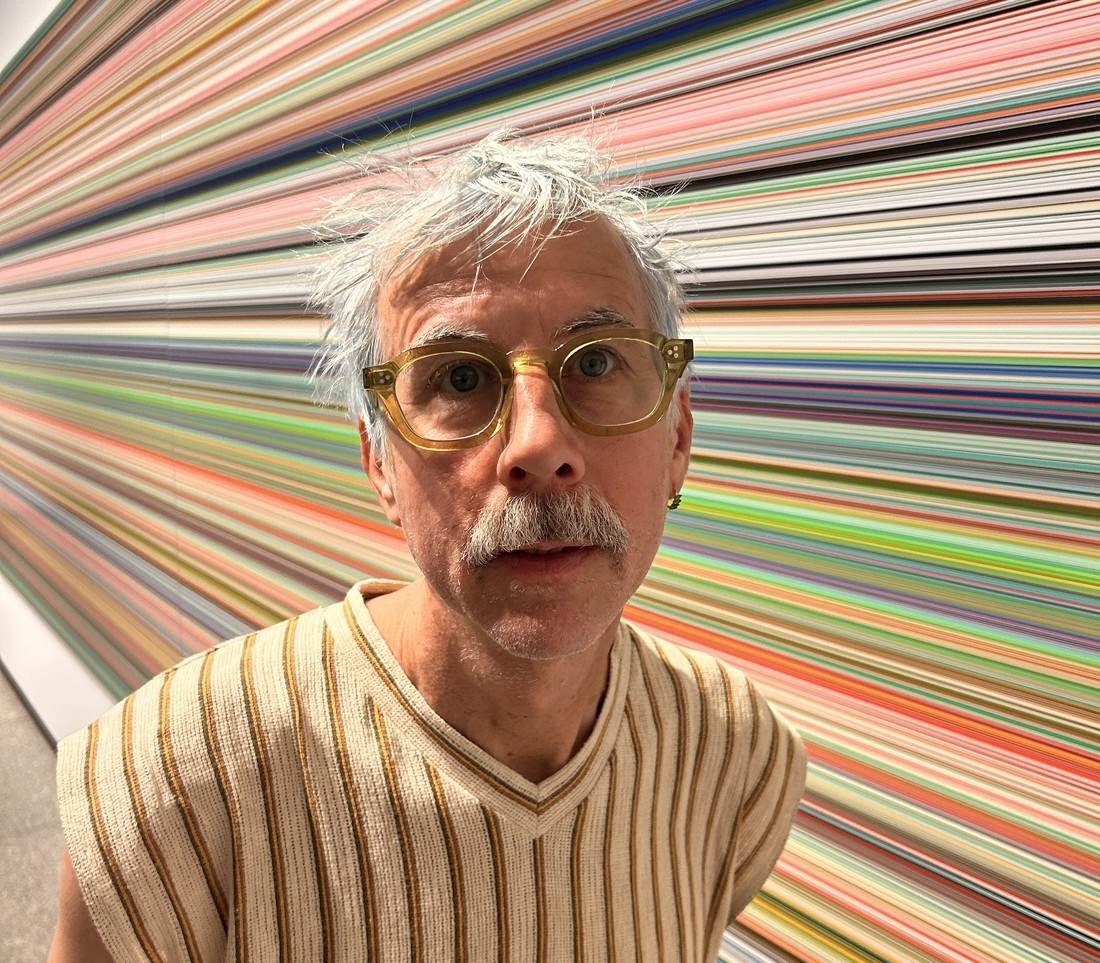
John Vanderslice is done being John Vanderslice—or at least the version people thought they knew. After decades as a meticulous singer, songwriter and studio obsessive, he’s spent much of the past decade abandoning the conventions that had defined his earlier work while delving ever deeper into the electronic realm. Eventually, even his voice was MIA.
And that was fine with Vanderslice—but his wife, Maria, felt differently. She missed his singing. Then she began handing him lyrics of her own. Focus (Tiny Telephone) provides more convincing evidence of their fruitful collaboration. Recorded with longtime collaborator James Riotto between Vanderslice’s Tiny Telephone Recording in the Bay Area and his small backyard studio in Los Angeles, Vanderslice’s 19th solo album reaquaints acoustic guitars and traditional songcraft with the electronic disruption of 2022’s d E A T h ~ b U g and the following year’s Crystals 3.0. Both veteran engineers, Vanderslice and Riotto approached the Focus sessions intent on resisting the habits that accompany expertise—working quickly and instinctively.
Not long after finishing the album, Vanderslice and his wife relocated to the Netherlands. MAGNET’s Hobart Rowland caught up with him there.
At its core, Focus feels like a singer/songwriter album, even though it incorporates everything you’ve been doing electronically over the past decade.
I’d really shifted toward a lot of electronic music and away from songwriting. Part of that is that it’s hard to write a song—it’s agonizing. My wife was writing poetry, and she gave me some lyrics. I’m not going to just praise something because my favorite person in the world wrote it, but I was like, “These are fucking good lyrics. Can you keep writing?” It felt like I had this magic fucking genie lamp. She was writing better lyrics than I could write if I put my whole life force behind it—and I was stoked. She wrote three albums of lyrics for me. All the Google Earth stuff (also with Riotto), and then this record.
And singing?
I needed to stop—and what’s wild is that now I’m singing all the time. It’s so fun … It’s like my favorite thing. But you need to disappear. You need to defy expectations. For years, I was like, “I have no idea what I’m doing.” Some of the transitional stuff I listen back to now, and I’m like, “It’s not really believable.” But it’s all part of the cycle. You go through the transitions and then, all of a sudden, you get somewhere special. I love this record. So much credit goes to my wife because she gets this old-school JV vibe with the lyrics. She has this really dangerous, funny sensibility.
You’d never know from listening that someone else wrote the words.
She understands me. She knows what I think is funny and what I think is compelling. We consume the same media and the same music, so we’re in the same world. The first track on the record is inspired by Ingmar Bergman’s From The Life Of The Marionettes. We saw the movie in the middle of the night, and she wrote it. She’s like a savant. She can just write stuff.
When Maria uses “I,” is she writing as you?
It’s the character. Not me, not her, but an unknown figure, which is great for listeners because it lets them superimpose whatever they want onto the text. It’s our favorite writers—the Dan Bejars, the Darnielle types, the Bermans—where you’re just like, “Wait, who? How much of this is autobiographical and how much of this is fantastic?”
You did write one song yourself, “Song For Maria.”
Maria said, “You write me one goddamn song.” And I said, “OK.” It was hard. I know what I’m good at. I don’t have weird ego issues about saying, “I’m good at this. I’m not as good at this.” That’s how you curate an art career. It’s knowing who to tap into and who to bring on. I’m not good at playing percussion, so Andrew Maguire plays on the record, and he’s a genius. James was brought in as a producer because he’s a genius. I love that people can have clarity and piece things together.
You and James both have an enormous amount of recording and engineering experience. Can knowing too much interfere with instinct, accidents and surprise?
No, because James and I have spent thousands of hours together. Philosophically, we’re on the same track. We listen to a lot of the same music, which tends to be chaotic and dismissive of technical considerations. As I’ve gotten older, I’ve become less patient with my own fussiness. I can work really quickly now. When I first started recording around 2000, I was so neurotic. The studio is like a hall of mirrors. You’re confronted with hearing your voice on tape. You’re shown how poorly you play in high resolution. It fucks with your head. Around 2017 or 2018, James and I were making records that involved hybrid analog/digital recording—electronic records on analog tape decks, all this MIDI equipment, gear from the ’70s and ’80s that had no business being asked to operate that accurately in a modern studio. It was brutal. Months of technical problems. After those records, we got much more guerrilla in the way we worked. It became: “Let’s work fast.”
Did having the studio in your backyard help change that mentality?
That was the main thing. James would come over a couple times a week, and it was so casual. The door was always open, so you’d hear birds, you’d hear people, kids playing in the playground. And you’re like, “Why am I getting so worried about this microphone?”Recording becomes more fun and a little more violent and messy—which you kind of need because art can get really clean and structured and antiseptic. The better you get, you just clean up all the problems. Maybe the problems are really fun; maybe the problems are great.
What rules did you impose to keep yourselves from slipping back into perfectionism?
We’d record something, and our rule was that we’d never listen back to it. If we felt like we enjoyed the experience, we’d never listen to it again. And we’d never solo tracks. Ever. We’d never isolate a recording and question whether it sounded good. We’re reasonably good engineers, so we didn’t make giant mistakes—and the gear is good. We accepted chaotic moments. Another thing that helped was that James and I were often both recording at the same time. One of us wasn’t engineering the other. I’d be singing or playing keyboard, and he’d be playing bass.We’re busy people—James has three kids. We’re not going to sit there for 12 hours and fuck around. It’s like, “Let’s make some weird art today, and then let’s go our separate ways.”
Focus became the last record you made in Los Angeles. Does knowing that change how you hear it now?
Yeah. The stuff we tracked there is what’s on this album. Honestly, I love Tiny Telephone. I live off Tiny Telephone. Maria lives off Tiny Telephone. We were able to move to Europe because of it. But I prefer the recordings I made in the backyard of my L.A. house. That studio was called Grandma’s Couch.
Where did the album title come from?
Maria and I were really high in L.A. one night, and we passed this telephone pole. Somebody had written on the reflective banners: “FOCUS. Suck your dick. FOCUS. Fuck your ass.” There were drawings and stuff. Maria had her digital camera with her—a Sony point-and-shoot with a flash—so everything looks like that Vice-era American Apparel thing. She took a photo. We didn’t think anything of it. Then I looked at that photo a week later and thought, “This is Los Angeles for us.” It was everything about L.A., about us, about getting high just to be able to handle living in the neighborhood we lived in. And we loved a lot about L.A. I have so much respect for the art community there, the city, the history of film, the history of media. It’s a fucking beast. It’s incredible. The food is unbelievable.When somebody says something negative about L.A., I’m like, “You don’t know anything.” I can criticize it. I lived there. People who live there can tell you how fucked up it is. But it’s also a miracle.
What did relocating overseas do to your brain creatively?
Moving to another country, another continent, is like a megadose of LSD. It completely paralyzed us. It scraped all the plaque off our brains. It rerouted our synapses. It was incredibly powerful, very painful, super beautiful, really lonely—like, “What have I done?” But we’re also the happiest we’ve ever been.
Why Holland?
We came here on tour in 2022. We were in Utrecht, and it was this beautiful day. We were walking around and both looked at each other like, “Is this the greatest city we’ve ever been in?” Maria has Dutch family, so she’d been to the Netherlands a lot, and I’d probably been here 30 times on tour. When we got home, our landlord was coming back to the house we’d rented in L.A. for six or seven years. We started looking at rents and realized we might have gotten priced out.We looked at upstate New York. We looked at Kansas City. We looked at a bunch of places. And then Maria said, “What if we looked at the Netherlands?” Once we started looking seriously, it became possible. We have an artist visa. We could rent a place in Haarlem for way cheaper than what we were paying in L.A. The cost of living is cheaper. You don’t own a car. Your life is simpler. We wanted to live somewhere where everybody has health insurance. No guns. A feeling of community and safety that’s universal. Here, those are givens.
Do you feel like you belong there now?
We’re never going to leave. I think it’s a profoundly beautiful place to live. But we’re guests—and we act like it. The Dutch fucking know how to build a city. There’s still this incredibly robust middle class and social safety net. Of course, they have frustrations with housing prices and lack of housing—the same stuff you have in the United States. But we put two years of planning into getting here. We’re model visa holders. We’ve made dinner for literally every person on our block. We pay taxes. We don’t cause problems. We’re happy to be here.
Maria describes Focus as an artistic and personal rebirth for you. What does reinvention actually mean to you these days?
Maria was always really sad that I’d dismissed singing. She knows me because her ex-boyfriend was a fan and gave her my record. That’s the only reason I have this amazing creature in my life. Maria was like, “I think you can come back to songwriting but reintegrate some of the stuff you’ve been doing.”And now I don’t want to let it go. I’m back recording almost every day. Maria records almost every day. I don’t want to let go of the voice. For years, singing bummed me out. A lot of singers have a very painful relationship with their voice and a painful relationship with writing lyrics. You’re staring at that blank page. You’re cracking yourself open. Too many years, too many days, too many hours. It’s hard. Now it’s not.
From the looks of the album cover, moving here has also given you more freedom personally.
One hundred percent. Maria art-directed everything about the record. The cover photo—she told me what to wear, what to hold. The peony came from the farmers market earlier that day. The “FOCUS” on the flower is actually a temporary tattoo she got. And when we moved here, the Netherlands really did have a completely different vibe. There’s a live-and-let-live quality. We started going to sex clubs—and I never in a million years thought I’d be going to a sex club. Even though I’m a social libertarian and I’m like, “Do whatever you want,” I just never thought that would be part of my life.
Here it’s more accurately like a sex rave—this incredible integration of electronic music with total anarchy. It’s some of the craziest shit you’ve ever seen in your life. And people on our block go to the same clubs. Everything is normal. People do drugs, live their lives and show up to work at 8 a.m. on Monday. It’s a country where the church hasn’t had that kind of power for hundreds of years. There just isn’t an ounce of some of the stuff that gets baked into other cultures. It’s just a different vibe here.
We’re not even the freakiest people on our block. And it makes you feel really happy. You realize, “Oh, it’s OK. Everything’s OK. Everything’s good.” You can do whatever you want as long as you’re safe, you communicate with your partner and it’s with love. That’s been a total rebirth for me—and for her. It’s been incredible.