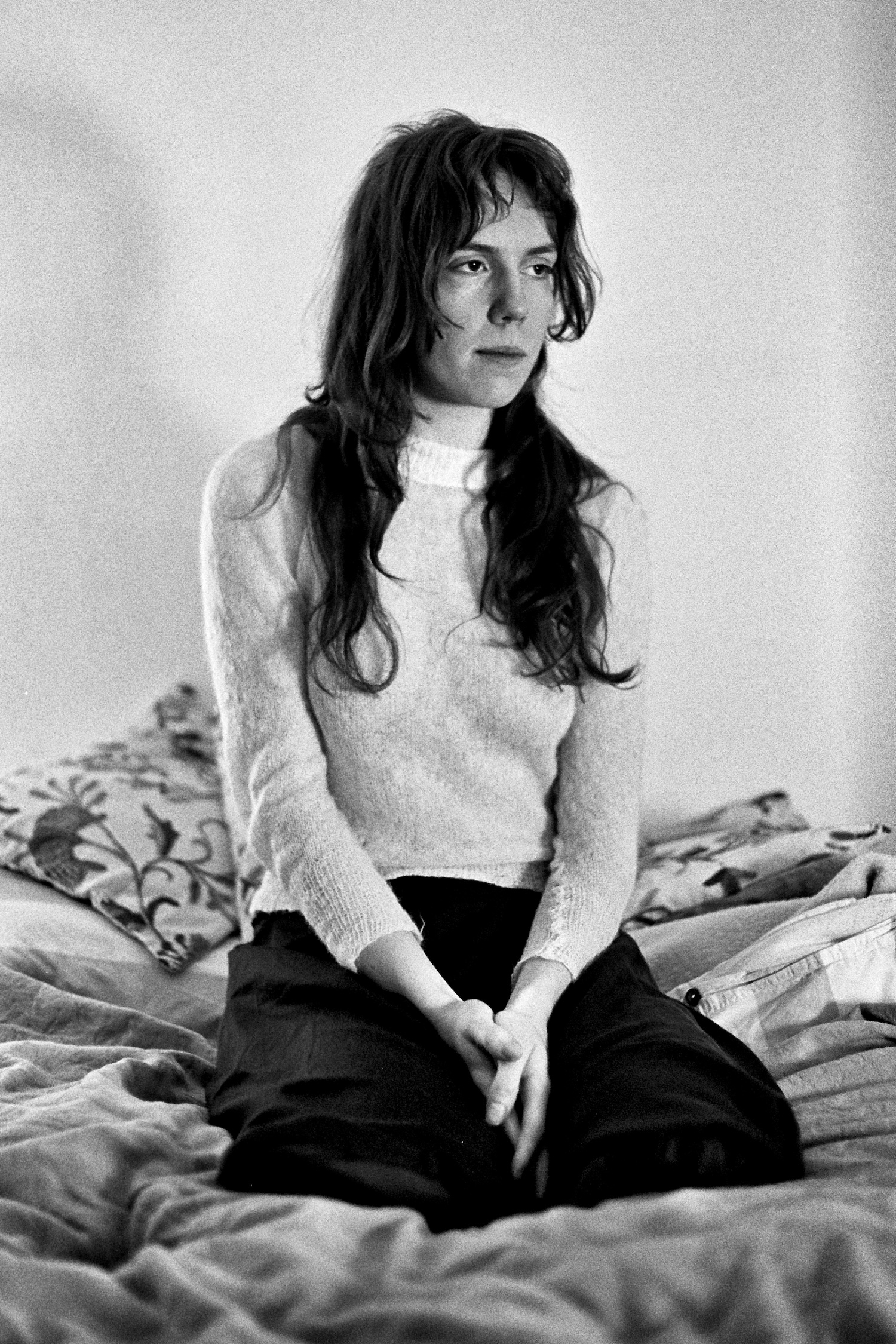
Though she’d already recorded one version of her debut LP, The Knife, The Needle (Merge), Elanor Moss felt there was something missing. More music followed, inspired by the typical list of songwriting greats, including Bob Dylan, Leonard Cohen and Joni Mitchell. Ultimately, the London-based singer/songwriter set aside much of what she’d already tracked and started again. This latest reassessment was the striking finale of an ongoing reset that had begun after a year-long creative drought.
Moss returned to the studio with producer/engineer Pete Miles (Orla Gartland, Dodie, Architects) and a new set of musicians, recording live to tape in a single room. Arrangements from Matthew Herd gave the new songs their carefully considered sense of space. Meanwhile, Andrew Stuart-Buttle, Marcus Hamblett, Reid Jenkins, Linus Fenton and Jools Owen joined Moss, Herd and Miles in shaping performances built as much around intuition as execution.
“By the time I was in the studio, I had a pretty clear vision about the sound,” Moss tells MAGNET’s Hobart Rowland. “It felt like most of the hard work had already been done and we just needed to capture it.”
Here’s more from Moss.
Prior to The Knife, The Needle, you’ve said that you reached a point where you were pursuing a particular sound rather than going with what felt natural to you. How did you find your way back?
I come from a love of the interplay between voice and guitar, and I felt like I’d lost some of my curiosity about what the two can do together, which felt like a shame. I took it as a sign that I needed to do some work in that area. Finding my way back involved a lot of intentionality and developing a way of “close listening” around my life and my music practice—not just listening closely to music that moved me but also listening to the current of everyday life. This meant a lot more walking, reading, journaling, asking questions of things—and more listening internally—to develop and stretch my intuition, which is as important to creativity as craft is.
“Sarah Waiting In The Car” ended an almost year-long songwriting drought. What was it about that song that opened things up for you again?
It helped me cross over into a new phase of my writing that felt markedly different from what I’d done before, while still being totally related. I felt like I’d done something with it I hadn’t previously been able to do in my songs, and that ignited more desire and curiosity to keep pushing.
Even when the trappings are lush, the new music retains a sense of restraint. How did you and Pete Miles determine when an arrangement should expand and when less was best?
It was a mix of mine and Peter’s insight, but mostly Matthew Herd, who wrote the arrangements for five of the songs. He’s a brilliant songwriter in his own right—and has his own debut album in the pipeline. He has a sublime sense of melody, which helps. His work largely looked after itself in that regard. There were a few songs we didn’t have arrangements for, and that relied on the players, me and Pete communicating about the right kind of arc.
How difficult was it to walk away from that original finished LP?
I realized a few months after finishing the New York version that I had more writing to do. Once I’d done more writing, I realized the core of the record was a little different to what I’d previously thought. And when the core of something changes, it requires a rearrangement of everything else around it. It’s not that there was anything wrong with the U.S. version—the thing that was “wrong” was that I hadn’t realized there was more writing left for it until afterwards. I took certain songs out of the track list that no longer felt they fit and added the new ones. Doing this totally changes the tone and feeling of a collection of songs.
You’ve said that therapy and examining your family history led to revelations about how your past affects the ways you love and receive love. How did those discoveries find their way onto the LP?
The main thing I carried of myself into the work was this attempt to approach characters with empathy even when they’re not behaving in great ways. We all have our darkness and mess, and maybe that means we’re more similar than dissimilar in some ways. We’re all loving from places that are raw and vulnerable, and often we’re just trying our best with what we have.
See Elanor Moss live.