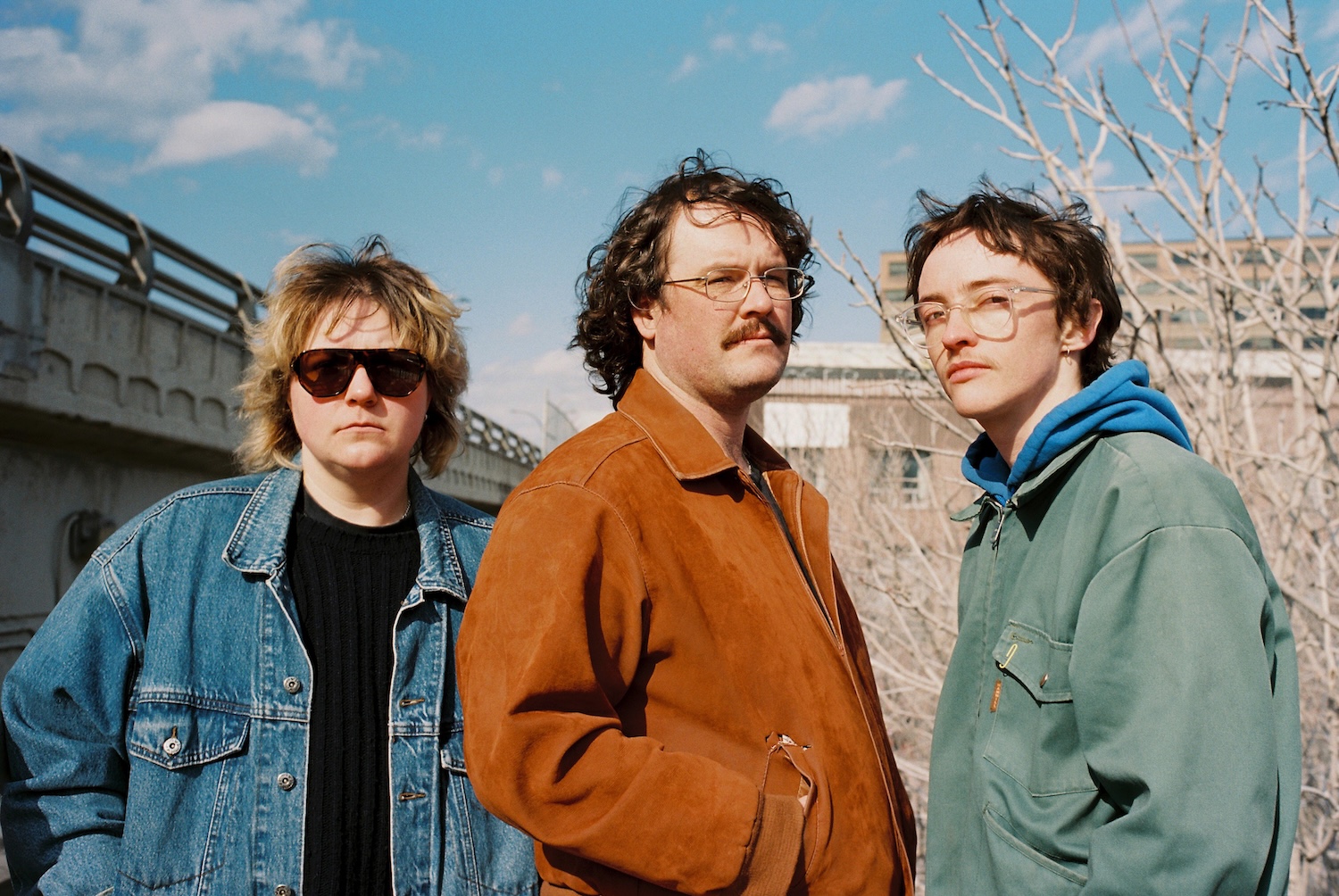
Knitting made quite the impression with Some Kind Of Heaven, a confident 2024 debut that reinforced the Montreal-based band’s hazy indie rock and revelatory songwriting with a deceptively vast emotional reach. The new Souvenir (Mint) further expands the trio’s sonic and thematic scope as it brings relatability and dignity to the struggles of an outsider—even if that means feeling just plain weird sometimes. The album is an in-house affair, with Knitting guitarist Sarah Harris handling production and engineering amid an intentionally collaborative process devoid of the pressures of a studio timetable.
MAGNET’s Hobart Rowland found out more from Knitting frontperson Mischa Dempsey.
Memory is a recurring theme on Souvenir. At what point did it become the album’s guiding principle?
I came up with “Souvenir” as a placeholder album title when we were applying for funding to make the record. I’d only written demos of two songs at that point: “I Want To Remember Everything” and “Exit Desire,” the closing track of the album. The word “souvenir” kind of resonated as a throughline. Both songs deal with wanting to escape something—in “IW2RE,” the weird or undesirable parts of yourself, and in “Exit Desire,” my perception of reality colored by depression. I think calling the album Souvenir was an antidote to that, a reminder that there’s a lot that’s worth holding on to. I tried to shape the album lyrically around that and ended up writing a lot about my fear of death and what that illuminates about my life … about what I want to remember from it.
“Here Comes” wrestles with the tension between self-improvement and self-destruction. Was that something you were actively working through while making the album?
It’s something I’ve always struggled with and will always struggle with. I chose to write about it from the perspective of my early 20s, when it was particularly obvious and the appeal of going out and the freedom to live chaotically was particularly tempting. The isolation of the pandemic forced me to reevaluate this dynamic and slow down. It also gave me time to figure out how to take care of myself a bit better, although it’s something I’m definitely still learning to do. Now I’m coming at this problem from a new angle: I struggle to implement a routine in a way that feels natural, and I feel like I need to remind myself it’s fine to lose a bit of sleep and let myself off the hook more.
“I Want To Remember Everything” feels like a conversation with your younger self. How has your understanding of that kid changed over the years?
I definitely didn’t understand why I’d felt certain ways as a kid until I was older. I think many people can identify the moment they become aware of the way the world interacts with them, of their differences—especially queer kids. Coming out as nonbinary as an adult was interesting, in that it connected me to a childhood version of myself that had the privilege of slipping between gender norms without an awareness of what I was doing. My mom worked and my dad stayed home to take care of me as a toddler. We’d go to the museum to look at dinosaurs and play with Hot Wheels. But I also watched Sailor Moon and loved wearing dresses. I think revisiting the things I liked as a kid without knowing much about their social connotations was a way for me to talk about the shame I felt when I got older and developed an awareness of my differences. I had a phase in sixth grade of trying to act really feminine. I grew my hair out and started wearing lip gloss and listening to Justin Bieber. I remember feeling as if I were betraying someone. As it turned out, it was me. For a long time after that, I was embarrassed about it. Now I understand better what was going on and what motivated me to try that out, and I feel more compassion both for that kid and the one who came before.
Souvenir was largely made on your own terms. How did that freedom change the way the songs developed?
We booked a week at a studio in St. John’s, Newfoundland, to record bed tracks, then finished the overdubs at Sarah Harris’ studio in Montreal. The knowledge that we could easily book more studio time was a bit of a blessing and a curse. It allowed us to go into recording with much vaguer concepts of the songs. Because Sarah was wearing two hats, it allowed us to make more creative decisions in the studio, and she wrote most of her parts while she was recording them. We could go down rabbit holes dialing in specific sounds without fearing we wouldn’t have time to finish everything. We even restructured certain songs after recording the beds. The end of “Photocopy” got a makeover; Sarah sped up the drums and came up with a new riff for the outro.
There also ended up being a lot of time between sessions, which we used to reflect on the songs. Because of our schedules, there were a lot of gaps between recording sessions for overdubs in Montreal. I was away for a residency in Berlin, we took a break to go on tour, and eventually, we paused for the Christmas holidays. While it did make it feel, at times, like the finish line was impossibly far, it allowed us to push the songs in new directions.
That DIY philosophy extends beyond the music into your videos and visual presentation. Why is it important that those elements feel just as handmade and personal as the songs themselves?
A lot of the time, we’re just making what we can with what we have. We made the video for “I Want To Remember Everything” over the course of a weekend with a budget of like $60, just roaming around the Montreal metro trying not to look too nuts. Because the video is completely handmade, filmed and acted and edited by us, it lends it a charm and earnestness. The point of being in a band and making music is that we like to be creative. Pushing ourselves within our means is another way of exercising our creativity and building out the world of the song.
See Knitting live.