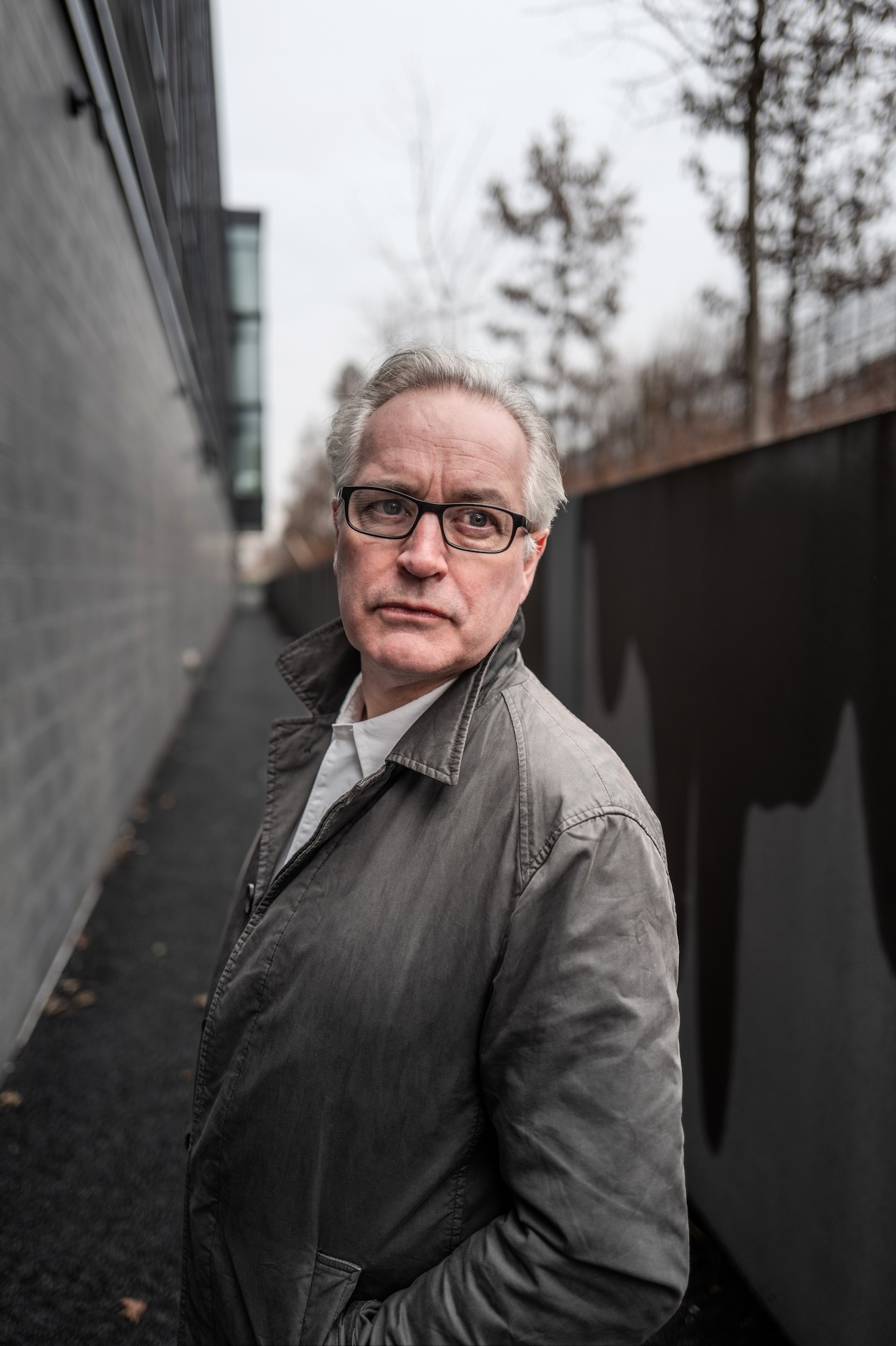
After 17 albums as John Wesley Harding and a more recent spurt under his given name, Wesley Stace has earned the right to make pretty much whatever sort of records he wants. On One Last Heist (Pravda), the longtime singer/songwriter pushes decisively beyond the strummy folk/rock that once defined him, drawing on jazz, soul, Brazilian music, orchestral pop, vintage soundtrack grooves and more to flesh out some of the most expansive arrangements of his career.
The album reunites Stace with longtime collaborator David Nagler, who co-wrote, arranged and produced the new LP. Their approach was partly a reaction to 2021’s Late Style, whose pandemic-era circumstances forced musicians to record separately when Stace and Nagler had envisioned something more elegant and communal. For One Last Heist, they gathered at Studio 1935 in Philadelphia’s Bok Building with bassist Eddie Carlson and drummer Stéphane San Juan, working up the arrangements beforehand but leaving enough space for the musicians to interact and improvise. Later, guitarists Joe Gore and Justin Mazer, drummer Patrick Berkery and a far-flung cast of friends supplied everything from backing vocals, flute and strings to horns, clarinet and percussion.
One Last Heist casts a remarkably wide net, and Stace surveys the haul track by track.
—Hobart Rowland
1) “One Last Heist”
“Metaphor? Reality? Is it a story? Is it my last record? It doesn’t matter. I just heard this song played on the radio for the first time, and the DJ described it as a cross between the theme to a Michael Caine movie and Steely Dan, and I would say that’s spot-on. In fact, those CTI records—with which I am, fair to say, obsessed—became the blueprint for the vibe of many a ’70s cop-show theme, so it’s perhaps inevitable that we’d push a song in that direction. David and I share a common love for David Axelrod’s twin albums Songs Of Experience and Songs Of Innocence, and I know that was an influence—as well as ‘I Am The Black Gold Of The Sun’ by Rotary Connection from their incredible album Hey, Love album. Eddie’s bass playing at the end here is just phenomenal.”
2) “Penelope”
“It wouldn’t be one of my records unless there was an excursion into mythology. This time—coincidentally, given the recent blockbuster movie—it’s The Odyssey, a song originally titled ‘Tales Of Brave Penelope.’ I thought that sounded patronizing, so I whittled it down to her name. The production references Gerry Rafferty, a songwriter I love. Appropriately, there’s some stellar sax by Stuart Bogie.”
3) “A Funny One”
“This was the very first backing track we recorded for the album. It has such a beautiful, summery feel to it—so dreamy, effortless and sun-dappled, despite its labyrinthine key changes. A weird subject matter perhaps: the uphill struggle of a mismatched relationship—in this case a songwriter and the person whom he’s been assigned, or chosen, to write songs about. There’s an attraction, but the relationship is doomed—dogged by misunderstandings. The songwriter has finally diagnosed the problem and, in conclusion, decides to write one final song: ‘I’m not wasting our time anymore.’ As far as I am concerned, this is a happy ending. He’s setting them both free and moving on. Clearly there’s quite a lot of Bacharach in this song.”
4) “Hanging Up The Sickle”
“I love the setting of this song, and I also like the story, which emerged as I wrote it: death, hoping to retire, foists his crown upon an unsuspecting, unconvinced stranger. It’s a phrase I heard—or perhaps misheard—somewhere ages ago, and it’s been hanging around in my notebooks. I know that David’s initial inspiration for this was Gary McFarland’s ‘Wine And Bread,’ a song I adore from his wonderful 1965 album, The In Sound. I often send David stuff I really like for inspiration, though he might travel quite parallel to it. Here, he took the lyric to Cuba: mambo and cha-cha—Arsenio Rodriguez, he tells me.”
5) “This Knowledge Dies With Me”
“The rather eerie and then very epic track suits the narrator: a cracked visionary offering his work to a—possibly—oppressive scientific board. The idea came from a book I’ve had for many years published by the Museum Of Jurassic Technology (one of my happy places) called No One May Ever Have The Same Knowledge Again. It’s a collection of letters written from 1915 to 1935 to the Mount Wilson Observatory in Los Angeles by people of varying degrees of sanity and insight. The loneliness and arcane points of view touched me, and a song finally emerged many years later. Mr. Nagler gave this one an astonishing melody and a great arrangement, which I suggested get even crazier in the last verse. We torqued it until it could yield no more.”
6) “Get It In Your Fingers”
“I’d like to sing this live in front of a hot band as I click my fingers and look like Bobby Darin. I’d thought ‘get it in your fingers’ was a well-known phrase … Seems like it should be. The song is all about muscle memory. You can learn something, but you can’t really do it without thinking until it’s deep in your memory. A couple smart people—Barry Gifford, for one—said my last album reminded them of Bob Dorough a little. There’s more here in the delivery … and maybe a little Thelonious Monk in the arrangement. The solo section was completely out to lunch at one point, and we had to rein it in a little.”
7) “In Our Own Time”
“It’s the story of two humans simply trying to divine the end of the mystery of it all—and how patience plays its part. They end up splitting up and, in that moment, finding the kind of harmony they needed to stay together. We wanted some extra-characterful electric guitar on the record. While I was considering who that might be, I happened to be on the West Coast on tour. From a motel in San Diego, I got in touch with Joe Gore, whom I’d collaborated with many years ago and seen playing brilliantly with Tom Waits and Tracy Chapman. I took the tracks over to him, and we had a beautiful afternoon discussing the parts. Then he sent them on to me upon my return. Blissful really. He’s on four songs here.”
8) “I Say Lots Of Things”
“On Late Style, I really enjoyed the playful recording and subsequent live versions of ‘Come Back Yesterday,’ particularly in the context of its lyrics. I wanted more of that protest, so this time it’s ‘I Say Lots Of Things’ and the less fun ‘Thoughts And Prayers’ … protest from two different angles because some things are so grim you can’t make fun of them and some things are so ludicrous that comedy is the only possible response. The song is a samba. David started off in a Cuban style, but I nudged him more in the direction of Brazilian fusion. Our drummer, Stéphane, is a master of this style and was very helpful in us nailing it—dissecting the bass part and writing a new one with Eddie on the spot. And on the percussion, another master: Gustavo di Dalva, who’s played with Gilberto Gil. We were exceptionally fortunate in our musicians on this record, particularly when we were trying to do something a bit more ambitious.”
9) “Not My Speed”
“As ever, there’s romance askance. Here we have two lovers who are entirely opposites. I just love the groove of this song—and as with many of our collaborations, I went back over the original lyric once I’d heard the direction David was going in. The starting point was James Gadson’s drumming with Bill Withers. I really love the chorus where the song opens out. That’s why I wanted the Herb Alpert horn, played by Matt Cappy.”
10) “Thoughts And Prayers”
“It’s harder to write a serious protest song than a satirical one. Once I got David’s demo of my lyric and he’d worked with me to provide a more conclusive ending, we both thought we might put real strings on it. In the end, that seemed way too much—like pleading for sympathy. I’d suggested something a little like Gerry Rafferty’s ‘The Right Moment,’ only with drums. Apparently, David took that in but missed the ‘with drums’ part entirely. The result was this piano/synth ballad.”
11) “Hello Dead Horse”
“This lyric was written many years ago and performed live with an entirely different melody with the Minus 5 in Seattle at least once. Now it finally appears on a record 30 years later. This is equal parts Gilbert O’Sullivan and Burt Bacharach. I was first introduced to the piano/whistle double by Brian Lohmann (Johnny Lonely) in San Francisco in the early ’90s, and it blew my mind when I first realized that’s how Brazilian music achieved that wondrous effect. David came to the same realization completely by chance … Such a great sound. I’ve been doing a lot of whistling recently, live and on my Secret Series. I remember there was a whistling competition at school when I was maybe 14. I didn’t win, and I was very offended because I’ve always been proud of my whistle. Is the guy who won whistling professionally these days? I don’t think so. Maybe around the kitchen though.”
See Wesley Stace live.