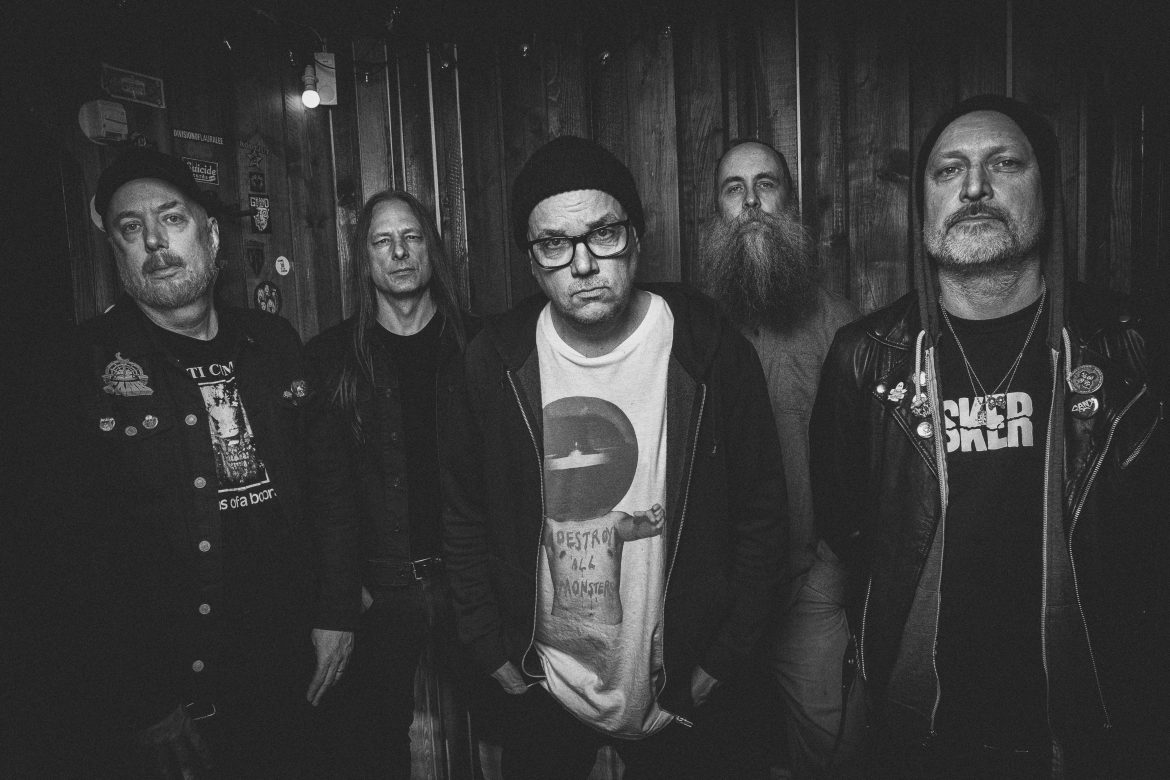

Disfear promo photo by Robert Samsonowitz in April 2025.
Just a few short weeks ago, Swedish crust legends Disfear announced that drummer Marcus Andersson died after a battle with an aggressive brain tumor. Not much more than a year before that, vocalist Tomas Lindberg—also of melodic death metal institution At the Gates—lost his own battle with cancer, 14 years after bassist Henke Frykman passed away, also via complications from cancer. What was not yet known was that Lindberg and Andersson had completed recording recording for The Last Nail, the first Disfear album since 2008’s Live the Storm.
Announced earlier today, The Last Nail is a triumphant moment, proof that, despite everything, Disfear are still torchbearers of the D-beat and crust sound. You can listen to “Early Graves,” the first track shared from The Last Nail (out November 20 on Relapse), and read an interview with founding guitarist Björn Peterson about the album, loss and moving forward to honor those who can’t.
The Last Nail is the first Disfear release in nearly two decades, but it comes after the loss of three band members—bassist Henke Frykman in 2011, vocalist Tomas Lindberg in 2025 and drummer Marcus Andersson just days ago. How did Disfear find it in yourselves to carry on as a band after facing such loss?
When Henrik left us back in 2011, it was a huge shock, even though we knew he was ill. We sat down in our rehearsal room right after his funeral and all agreed that we wanted to carry on. In a way, it was how the rest of us processed and dealt with the loss of a close friend.
Looking back on my own experience, I guess that was some sort of preparation for what was to come with Tomas and Marcus, even though you can never, ever be prepared for situations like these. We’re still far from being over it, and most likely never will be.
Being hardened by the loss of close friends, sharpened by life, and using grief as fuel to keep some sort of light on the horizon—that has become a driving force for me personally, and a way to keep moving forward.
The final song on the album, “The Last Nail in the Last Coffin on Earth,” was started back in 2012, which means some of the songs here are pretty old. How has the album changed musically from when you began work on it?
The outcome of the album isn’t that different from the vision we had when we started the writing process, at least not as I remember it. Of course, over such a long period of time, influences come and go, and if we had released it ten years ago, it would most likely have sounded somewhat different and perhaps more unbalanced.
At one point during the process, we selected the songs we wanted to focus on in order to find the nerve—the “red thread”—that would run through the whole album. That was kind of a turning point for us. It brought us closer together, gave us a clearer direction, and pushed us to finish the songs and finally step into the recording process.
When Disfear began to work on The Last Nail, the band was grieving Henke Frykman’s recent passing. As it approaches release, Tomas Lindberg and Marcus Andersson are no longer with us. Has the meaning behind the songs changed or expanded for you?
Personally, I’d say they have both changed and expanded. Memories from the writing and recording process come and go, which makes the songs feel even more special than I believe they would have had if Marcus and Tomas were still with us.
When it came to the lyrics, that was mainly Tomas’ part of the process. The rest of us weren’t really involved, apart from working on phrasing and bouncing ideas around, particularly when it came to the backing vocals. We knew the lyrics were great, and we could all stand behind them. It was just something that came naturally.
Now that he’s gone, I find myself seeing and reading the lyrics in a different way, which gives them a deeper and more expanded meaning for me.
The recording process was done at two studios—GodCity in Salem, MA and Welfare Sounds in Gothenburg. Was it difficult splitting the time between two locations?
I’d say that the recording process itself wasn’t that difficult, even though it was split between different locations. It was more the mixing process that became difficult—maybe “near impossible” is a more accurate way to describe it from our perspective, given everything that was happening and the timing involved.
We rescheduled the mixing with some distance from Tomas’ passing and funeral, and moved to Redmount Studios, where we worked with Magnus Lindberg (Cult of Luna) on the mix before finalizing the album with mastering by Sören Von Malmberg at Cosmos Mastering. Both studios are located in Stockholm, Sweden.
When we made the final decision to go ahead with the recording process, we had a really hard time deciding where to record. The only thing that was clear from the beginning was that we wanted to record the vocals at Welfare Sounds.
Obviously, going to Salem, Massachusetts, and recording the rest with Kurt at GodCity was our first choice, but, at the same time, it was quite a project and there were also financial considerations involved. The final decision was largely connected to Marcus’ situation. For him, recording with Kurt at GodCity was sort of a safe zone. There were other factors weighing in as well, of course, and we knew exactly what we would get from working with Kurt.
All of this was happening during an incredibly difficult period. We were aware of Tomas’ diagnosis, while at the same time knowing that, with Marcus, we were in a race against time. Our aim had been to complete the recording, mixing and mastering in a much shorter period, but given the circumstances, we simply couldn’t.
We are eternally grateful to everyone involved for their professionalism and patience during those difficult times, and for understanding our concerns and worries as we tried to do the best possible job of making the album the way Henrik, Tomas, and Marcus had wanted.
On the day he tracked his vocals, Lindberg was only supposed to make edits to existing vocal demos; instead, he knocked the whole thing out, as we hear it on the album. How did the band react upon hearing it?
Actually, most of the band were there with Tomas in the studio when he tracked it. Unfortunately, I couldn’t make it that day, but I got some very positive texts and pictures from the studio. To be honest, we didn’t pay that much attention to the tracks that weren’t meant to be recorded that day. Our main focus was on the edits and getting the demo tracking completed. At that stage, it was already clear to us that all the vocals would be re-recorded during the actual album sessions.
When we realized that we had to use the recorded tracks and got to hear them in the studio while preparing to record the backing vocals, I think we were all kind of blown away. There was never any question about using them on the album.
Ulf and I talked specifically about this the other day, and with a bit of distance from the recording, mixing, and mastering process, we concluded that Tomas’s performance on this album is the best he has ever done with Disfear. It fits the whole vibe of the album perfectly.
In all this grief and sorrow, it’s clear to us that Tomas left us with something truly special. His performance on this album is a beautiful final statement, and we feel incredibly proud of what he gave us. He went out on top.
There’s a definite rock ‘n’ roll feel to The Last Nail—a little more free than previous releases without losing the intensity. Was this a conscious songwriting/production choice or just how you evolved as songwriters over the years?
The songwriting came naturally over the years, and during the demo tracking, Ulf started to get a feel for the vibes and the strategy for how we would record it at a later stage. That, together with all of us evolving and gaining more experience, shaped the way the album eventually turned out.
We all grew up with rock and punk in the ’70s and early ’80s, and that stayed with us. Now, as we’re stepping into a more mature part of life, there are no given rules for how we should write or produce music. With that said, we simply do what we like. If other people like it too, we’re humbled and genuinely thankful.
It’s still hard for us to actually evaluate the result, though. Listening to the album is such an emotional roller coaster after having lived with it for all these years and considering everything that has happened along the way.
What does the future of Disfear look like? Will the band ever return to the stage or studio again?
We take one step at a time. That has been kind of a mantra for us during the past few years, with everything that has happened. Right now, our focus is on bringing The Last Nail out as a tribute to our friends who are no longer with us.
At the same time, the rest of us are still here, and the thought of playing these songs live is something that brings a little light to the end of the dark tunnel. We’re not ruling out the future of the band. We didn’t do it when Henrik left us, and we won’t do it now after losing Tomas and Marcus.
One step at a time…
